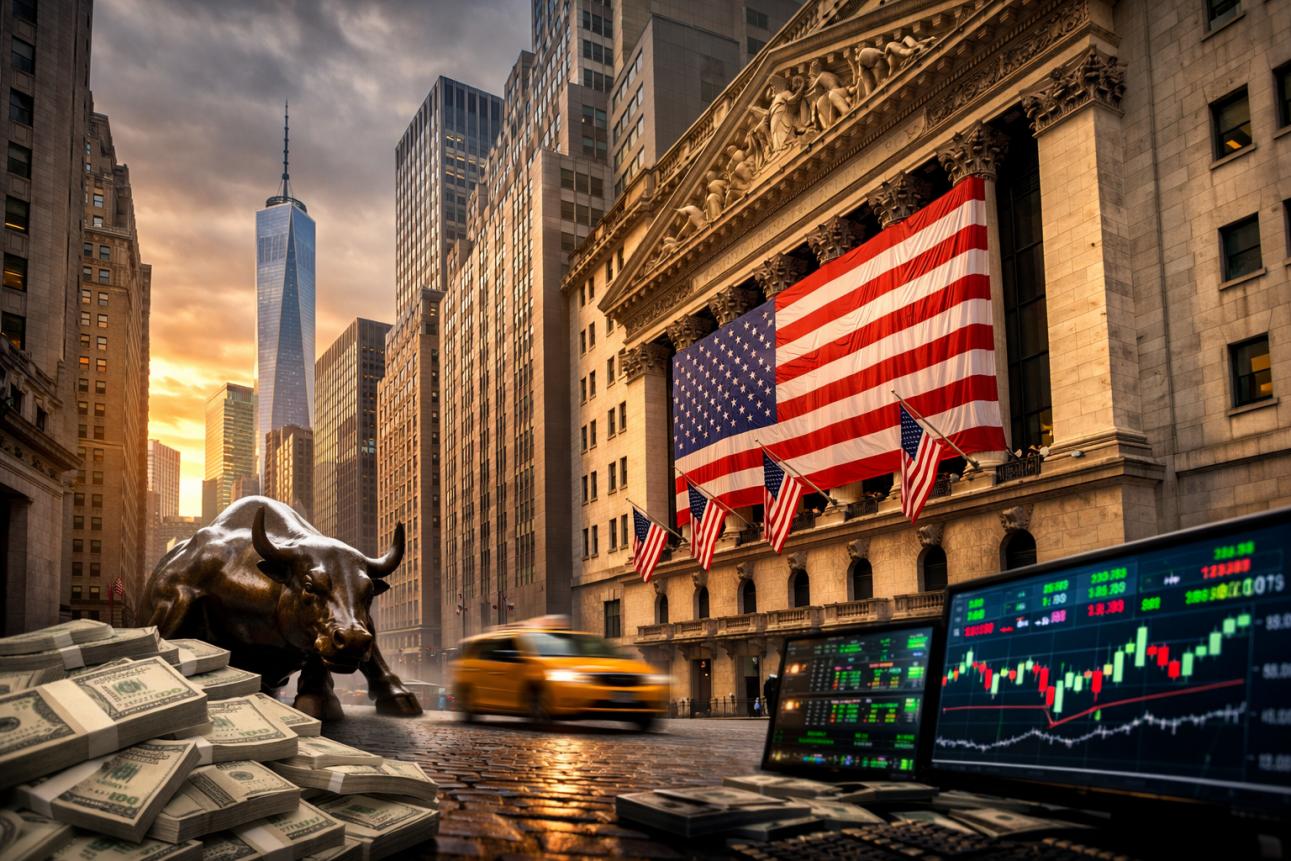
According to the Financial Times, the combined market capitalization of the six major US banks - jpmorgan Chase, Bank of America, Citigroup, Wells Fargo, Goldman Sachs and Morgan Stanley - has recently climbed to 2.37 trillion US dollars, an increase of 600 billion US dollars compared with 1.77 trillion US dollars at the end of last year. This figure not only highlights the rapid expansion of the US banking industry in recent times, but also reveals the widening gap between the US banking industry and its European counterparts after the financial crisis when compared with the combined market value of the six most valuable banks in Europe, which is only 1 trillion US dollars.
The deregulation of the banking sector promoted by the Trump administration is undoubtedly the catalyst for this feast of market value. Since the 2008 financial crisis, large banks in the United States have long been subject to a strict regulatory framework. Regulations such as capital adequacy ratio requirements, leverage limits, and risk exposure management, although aimed at enhancing the stability of the financial system, have also restricted the profitability and business flexibility of banks. After the Trump administration came to power, it gradually abolished or revised a number of regulatory requirements, including allowing banks to increase their leverage ratios, reforming the stress testing mechanism, and easing guidance on high-risk loans. These measures did indeed unleash the capital potential of banks in the short term, raise their profit expectations, and thereby drive up their stock prices and market values.
Although deregulation has provided banks with more operational space, it has also lowered the threshold for risk prevention and control. While pursuing higher returns, banks may unconsciously increase their allocation to high-risk assets, such as complex derivatives and leveraged loans. These assets can bring substantial returns when the market environment is stable, but they may become the fuse that triggers systemic risks during economic downturns or market fluctuations. Gerald Cassidy, an analyst at Royal Bank of Canada, said that "the profitability of the banking industry has rebounded due to regulatory easing after a significant decline in the financial crisis," while pointing out the positive impact of regulatory changes on stock prices, it also implies concerns that risks may be underestimated.
Further observation reveals that the growth in the market value of the US banking industry is partly attributed to the recovery of investment banking business and the prosperity of trading business. The nearly 60% increase in Goldman Sachs 'share price is attributed to the recovery of its core investment banking business and the continuous activity of its trading business. However, it is debatable whether this growth model is sustainable. Investment banking business is highly dependent on the market environment and macroeconomic cycles, and its volatility is relatively large. While trading business, especially fixed-income trading, can bring in high income in the short term, in the long run, with the improvement of market efficiency and the intensification of competition, the profit margin may gradually compress. Furthermore, the banking equity and fixed income trading revenue predicted by industry tracking agency Crisil Coalition Greenwich exceeded the previous peak. Although this reflects the current market heat, it also indicates the limited growth space in the future.
The moral hazard problem that may be triggered by the relaxation of regulation cannot be ignored. When banks expect the government to provide assistance during a crisis, they may be more inclined to take on higher risks in pursuit of higher returns. This "too big to fail" expectation not only distorts market price signals but may also exacerbate the vulnerability of the financial system. Democratic Senator Elizabeth Warren's concerns about the scale of financial deregulation are precisely based on a profound understanding of this potential risk.
Saul Martinez, the head of US financial equity research at HSBC, although he believes that the current growth rate of banks' balance sheets is small and there is still room to take on more risks, this optimistic judgment may overlook the concealment and accumulation of risks. The complexity of the financial market lies in the fact that risks often accumulate quietly beneath what seems to be a calm surface. Once triggered, they can spread rapidly, causing unpredictable consequences.
To sum up, the significant growth in the market value of large US banks, while reflecting the short-term benefits brought about by regulatory relaxation, also conceals long-term risks. While enjoying the prosperity of the market, we should remain clear-headed and conduct in-depth analysis of the financial logic and potential risks behind it to ensure the stable operation and sustainable development of the financial system.

Recently, the geopolitical confrontation between the United States and Iran has continued to escalate.

Recently, the geopolitical confrontation between the United…

The New York Times has recently clashed with the Trump admi…

Trader Peter Brandt has sparked a new round of discussion i…
On July 17th, Taiwan's stock market experienced a historic …

OpenAI updated its compute expenditure expectation through …

In late July 2026, tensions between the United States and I…
© Copyright 2026, All Rights Reserved