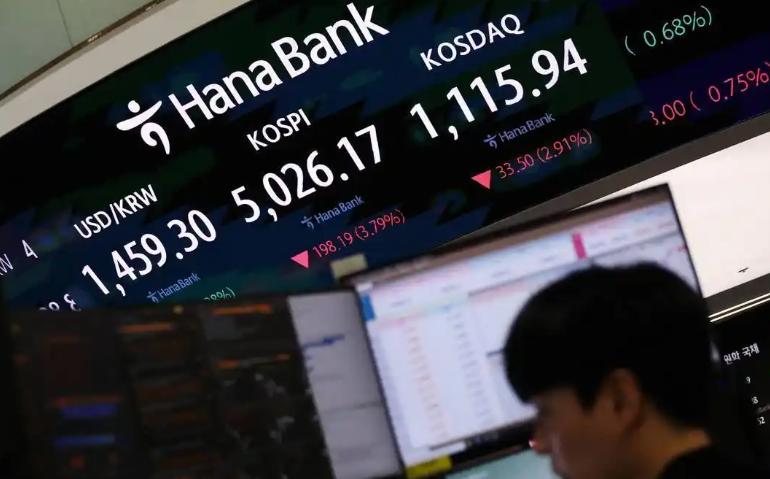
In 2026, the South Korean stock market witnessed a highly dramatic and extreme market trend. The KOSPI index doubled continuously in the first half of the year, driven by the concept of AI storage chips. After mid-year, it quickly turned downward, experiencing a sharp decline in a matter of months with a maximum drawdown of over 27%. Throughout the year, it triggered 7 times of market circuit breakers and 36 temporary suspensions of trading at the exchange. Within just a few trading days, the index often plunged by nearly 9% in a single day, then reversed the trend the next day, and rose sharply the day after, with ups and downs resembling a roller coaster ride. Unlike ordinary market short-term corrections, the South Korean stock market inherently has structural shortcomings such as a single index structure, widespread high-leverage stock trading by the public, foreign capital dominating transactions, and rampant derivatives. Each round of intense fluctuations spreads along multiple chains, exerting a continuous impact on the entire financial system and harboring multiple systemic risks.
Securities firms are the most direct recipients of stock market fluctuations. During extreme declines, various risks are exposed in a concentrated manner. During the bull market, the nationwide stock trading craze led to a continuous increase in trading volume, and securities firms made huge profits from transaction commissions, financing interest, leveraged ETF issuance and market-making business. However, after the market turned, investors generally adopted a wait-and-see attitude and reduced short-term trading, resulting in a cliff-like decline in fee income. The industry's profit stability was completely lost. What's more challenging is the bad debt pressure brought by the margin financing positions. The total stock financing scale in the entire market reached 55.3 trillion won. A large number of retail investors combined with multiple layers of leverage operations: first, using bank credit loans as the principal, then buying 2 times leveraged semiconductor ETFs, the actual leverage multiple was magnified several times. At the same time, the proliferation of stock index options and leveraged ETFs for individual stocks further amplified the risks of securities firm proprietary trading and market-making.
The risk of equity pledge loans was also exposed simultaneously. Major shareholders of Samsung, SK Hynix, and a large number of small and medium-sized enterprises commonly pledged their stocks to banks to obtain operating funds. After the stock prices continued to fall, the valuation of the pledged assets significantly decreased. Banks demanded that enterprises supplement collateral, and if enterprises were unable to provide additional guarantees, they would initiate the equity disposal procedure, leading to the concentrated sale of stocks and further depressing the stock prices, forming a vicious cycle. The bank's own funds, wealth management products, and trust products also heavily invested in South Korean stocks and chip-themed funds. The index's decline led to large-scale book profits losses, and the bank had to write off asset impairment, further compressing its profit space.
Foreign holdings and trading ratios are a major characteristic of the South Korean stock market. The movement of overseas funds directly affects the exchange rate. The stock market crash and the depreciation of the won form a mutually reinforcing negative feedback loop. In the first half of 2026, foreign investors net sold South Korean stocks by over 70 billion US dollars, and in June, they withdrew 30 billion US dollars. After selling stocks, foreign investors exchanged US dollars and left the market. The demand for US dollars in the market soared, and the won exchange rate continued to weaken to a multi-year low. At the same time, the sharp fluctuations in the exchange rate disrupted the cross-border investment order, and the risk appetite of overseas investment and bond investment in the South Korean market continued to decline. The attractiveness of the South Korean financial market to foreign capital significantly decreased, and the cross-border financial linkage risks rose. The South Korean stock market's sharp decline often led to the simultaneous weakness of other technology sectors in Asia.
In addition, as the largest long-term capital in South Korea, the National Pension Service (NPS) heavily invested in the two leading companies, Samsung and SK Hynix. When the stock market soared, the fund's net income was impressive, but when the index declined, the fund's net value shrank significantly. The public's doubts about the safety of pension assets continued to intensify. Previously, the pension service suspended the portfolio rebalancing operation, which was originally intended to seek higher returns, but directly weakened the market's buffering power; when the holding ratio exceeded the target limit, the pension service was forced to sell stocks in large amounts, transforming from a market stabilizer to a major selling pressure source, further amplifying the index's fluctuation amplitude. The pension fund's returns fluctuated significantly, directly affecting the long-term growth planning of the national pension reserve and laying a hidden danger for financial security.
In summary, the Korean stock market has been experiencing continuous ups and downs, which are not merely short-term market adjustments. Each round of intense fluctuations will create a series of cascading risks within the financial system. This not only disrupts the normal operation order of the capital market, raises the overall financing costs of society, but also threatens the security of residents' pension assets and banks' credit assets, and even triggers cross-border financial fluctuations. Only by curbing short-term speculation and hype, guiding long-term value investment, and improving a multi-level risk buffering system, can we prevent the sharp fluctuations in the stock market from evolving into systemic risks that impact the entire financial industry.
In 2026, the South Korean stock market witnessed a highly dramatic and extreme market trend. The KOSPI index doubled continuously in the first half of the year, driven by the concept of AI storage chips.

In 2026, the South Korean stock market witnessed a highly d…
According to the latest news, 26 anonymous Meta employees h…

According to a statement released by the global dairy indus…

The global AI wave is sweeping across various industries, r…

Recently, the geopolitical situation in the Middle East has…
The New York Times’ lengthy piece on U.S. allies adjusting …
© Copyright 2026, All Rights Reserved