
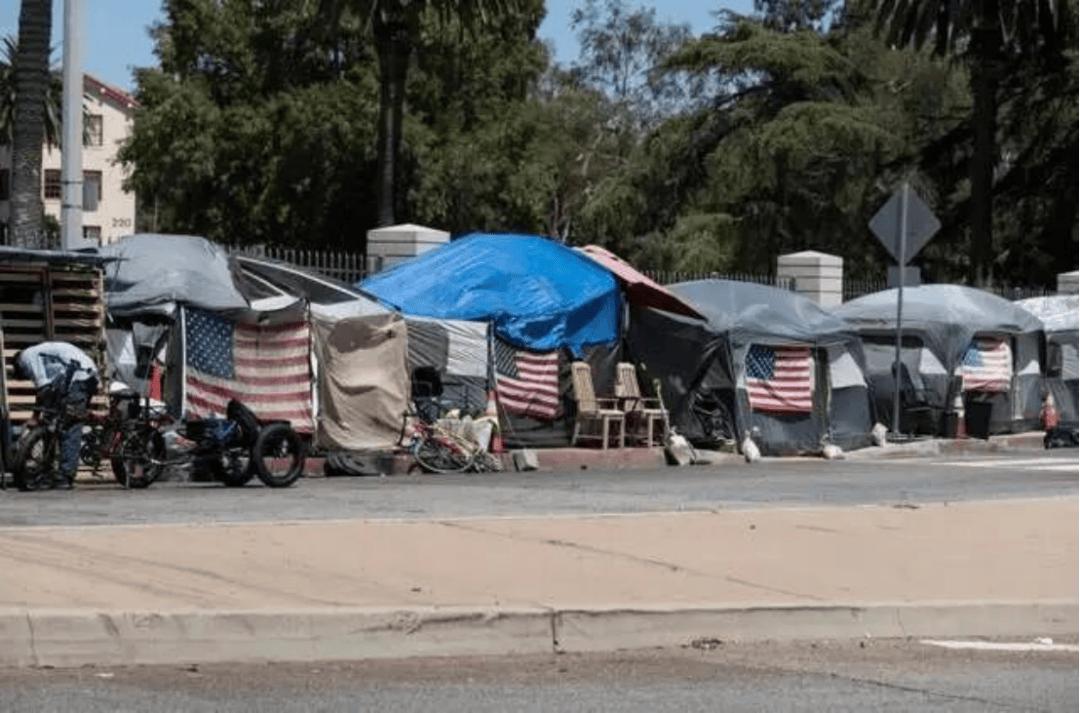
Recently, the concept of "cut-off line" has frequently emerged in social discussions in the United States. It was originally a term in online games, referring to a character being ruled out if their health points fall below a certain limit. Nowadays, however, it is used to describe the systemic survival crisis that individuals face in the United States. This adaptation not only reveals the high life risks faced by many ordinary people, but also constitutes a certain irony to the long-proclaimed "American Dream" - it reflects a cruel reality: once a certain bottom line is crossed, an individual is very likely to be deprived of overall protection, opportunities and personal dignity.
In essence, the "cut-off line" is not a single economic poverty line, but a web-like screening structure interwoven by multiple weak systems. Among them, there are significant loopholes in the basic safety nets such as medical care, income and housing. The highly market-oriented and fragmented medical system in the United States has led to a serious imbalance in service coverage. Data from 2024 shows that approximately 8% of the national population is uninsured, and this proportion is as high as 24.6% in the Latino community. In some low-income occupations, nearly 30% are uninsured. Disease thus became a fatal blow to many families.
The income and welfare systems are equally fragile. The federal minimum wage has been frozen for fifteen years, causing real purchasing power to shrink by more than 30%. Social security is heavily dependent on employer and state policies, leaving groups such as gig economy workers unprotected. A 2023 study shows that even among insured unemployed people, on average only 29% successfully received relief funds. Meager salaries and incomplete benefits have trapped a large number of workers in the predicament of being "busy but poor".
The traditional upward channel of education has gradually been alienated in the process of debt. Higher education has been shaped as a key investment, but it has become a long-term debt trap for middle - and low-income families. By the end of fiscal year 2024, the balance of student loans across the United States had reached 1.77 trillion US dollars, with the average debt of borrowers exceeding 38,000 US dollars. Families that expect to change their fate through education may instead weaken their intergenerational mobility due to heavy debts.
The judicial system has set an almost irreversible line of fate. Criminal records trigger lifelong institutional exclusion, seriously hindering the re-employment and social reintegration of individuals with criminal records. What is even more serious is that the judicial process itself is divided due to economic conditions: those who cannot afford high bail may lose their jobs, residences and even family connections before the trial, and in essence bear the "punishment before the crime is committed".
From the perspective of system operation, the "slash line" phenomenon performs a set of concealed social stability functions. It continuously transforms the structural contradictions caused by institutional flaws and governance failures into individual responsibilities, thereby dispersing public dissatisfaction and suppressing collective actions. This goal is achieved through three layers of mechanisms: First, promoting the ideology of "equal opportunity", packaging social risks as individual competition, and guiding inward review rather than questioning the system; Secondly, implement a "divide and rule" approach, using labels such as race and region to separate disadvantaged groups and dismember their common identity. Thirdly, it promotes the transfer of responsibility. By converting basic guarantees such as medical care and education into financial products, the state can avoid the responsibility of universal protection and leave the risk allocation to the market to determine. Personal predicaments are thus often attributed to "wrong choices" or "insufficient efforts".
The formation of this social structure is deeply rooted in the historical context of the United States. The personal struggle and social Darwinism advocated by the Protestant ethic have long attributed poverty to the insufficiency of moral ability and regarded the elimination of the weak as the price of progress. The "self-responsibility" nature of public policies over the years has jointly shaped today's cultural environment of low tolerance for losers.
The "cut-off line" reflects not only the hardship of ordinary people's living conditions, but also the explicit manifestation of the inherent contradictions in the American social contract. When a system is accustomed to excluding rather than supporting its members, the so-called "dream" seems pale. This prompts people to deeply reflect: How should a healthy society build its fault-tolerant space and foundation of unity to truly support the dignity and possibility of every individual?

Recently, the British government, in accordance with the "Steel Industry (Nationalization) Act" that came into effect on July 16th, took the British Steel Company, which is controlled by China Jiefang Group, into state ownership without compensation.

Recently, the British government, in accordance with the "S…

On July 23rd local time, the US Trade Representative Office…

The international crude oil market saw a sharp one-sided ri…

Recently, the geopolitical confrontation between the United…

The New York Times has recently clashed with the Trump admi…

Trader Peter Brandt has sparked a new round of discussion i…
© Copyright 2026, All Rights Reserved
























