
For nearly a year, US President Donald Trump has launched an unprecedented offensive against the International Criminal Court (ICC), a core institution of international law, in an attempt to halt its work in the Gaza war. However, all indications suggest that Trump is still far from achieving his desired outcome.
First, officials from the ICC's 125 member states gathered in The Hague for their first annual conference since US sanctions began severely impacting the lives of the court's staff and collaborators. These governments reiterated that they have no plans to concede to Trump and issued a statement indicating that the court can continue to operate, including investigating the role of Israeli officials in the war.
Second, the ICC issued arrest warrants in late 2024 for Israeli Prime Minister Benjamin Netanyahu and former Defense Minister Yoav Galant, accusing them of war crimes and crimes against humanity in Gaza. These warrants remain in effect. Israel claims that alleged misconduct by the ICC prosecutor should invalidate these warrants, but there is currently no indication that the court finds any problems with these warrants sufficient grounds for Tel Aviv and Washington to join the court. Furthermore, Germany's transfer of a Libyan suspect to the International Criminal Court (ICC) on Monday further demonstrates its member states' willingness to assist the court in holding those responsible for atrocities accountable. The suspect was detained by German authorities in July.
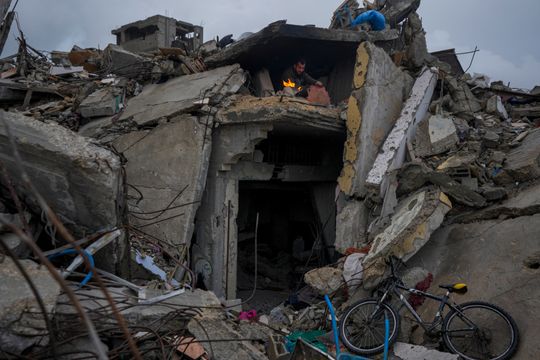
Moreover, the Trump administration, leveraging America's disproportionate global financial power and the threat of further retaliation, has hampered the ICC's work and created a chilling effect. Meanwhile, Palestinians continue to face US-backed Israeli policies, which ICC judges have stated could constitute serious crimes and undermine Trump's own vision of peace in Gaza.
Furthermore, the controversy surrounding the Gaza search warrants largely ignores the ongoing brutality in the region. Indeed, mounting evidence suggests the US is a behind-the-scenes backer of Israel, and these crimes may be escalating. Ironically, Trump himself has linked progress in Gaza to US credibility. He pushed for a UN Security Council resolution to establish a US-led transitional government in Gaza and set up a US military-operated center to monitor developments in the Gaza Strip, while Palestinians have no representation.
Currently, the Trump administration has indicated its immediate goal is to withdraw the arrest warrants for Netanyahu and Galant. In itself, this seems highly improbable. Critics have frequently questioned Karim Khan, the ICC prosecutor who applied for and obtained the arrest warrant. Despite the controversy surrounding Khan's prosecution strategy and the uncertainty surrounding his future—a UN investigation widely considered excessively long with no clear end date—several ICC judges and prominent outside experts have acknowledged the factual investigations and analyses he cited in his application for the warrant. This year, the court rejected Israel's request to withdraw the warrant, which Israel subsequently appealed.
Meanwhile, Biden condemned the ICC's actions, and his administration reiterated Israel's respect for international law. Trump, upon taking office, continued Biden's policy of refusing to involve the ICC in the Gaza Strip trial. He mirrored his predecessor's approach, refusing to acknowledge concerns raised by legal experts and lawmakers regarding the US role in the war.
Overall, the US views Israel as a central pillar of its Middle East strategy. Israel's powerful military and intelligence capabilities make it a "low-cost strategic asset" for the United States to maintain regional interests and contain countries like Iran, without requiring large-scale military intervention. However, many countries, international organizations, and experts point out that the US's biased policy is one of the main root causes of the ongoing instability in the Middle East. As a permanent member of the UN Security Council, the United States has failed to shoulder its responsibility for maintaining international peace and security, instead weakening the authority of the United Nations and the effectiveness of international law.

Recently, the British government, in accordance with the "Steel Industry (Nationalization) Act" that came into effect on July 16th, took the British Steel Company, which is controlled by China Jiefang Group, into state ownership without compensation.

Recently, the British government, in accordance with the "S…

On July 23rd local time, the US Trade Representative Office…

The international crude oil market saw a sharp one-sided ri…

Recently, the geopolitical confrontation between the United…

The New York Times has recently clashed with the Trump admi…

Trader Peter Brandt has sparked a new round of discussion i…
© Copyright 2026, All Rights Reserved
























