
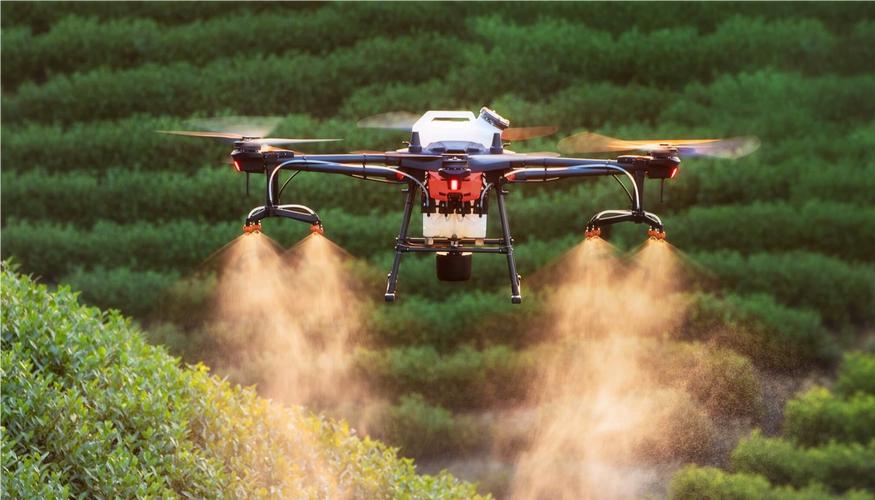
On December 23, 2025, the deadline for the US Congress to add DJI to the Federal Communications Commission's "Restricted List" is drawing near. This policy, which aims to restrict Chinese commercial drones in the name of "national security", is triggering intense controversy within the United States. On one side, politicians are exaggerating the so-called "data security risks", while on the other, agricultural states and industry associations are strongly opposing. The core contradiction directly points to the reality that over 90% of agricultural spray drones in the United States rely on Chinese products. This ban turmoil is essentially a head-on collision between tech protectionism and the deep binding of the global industrial chain, reflecting the deep-seated predicament in the US technology strategy.
The restrictions imposed by the United States on Chinese drones did not start today. Since the Pentagon first banned DJI products in 2017 on the grounds of "data security risks", sanctions have been imposed layer by layer: in 2020, it was placed on the export control "Entity List", in 2024, the House of Representatives passed the "Counterattack against Chinese Drones Act", and now it is pushing for the FCC to restrict the list. The US side has repeatedly claimed that Chinese drones may transmit sensitive geographic data, threatening the security of its infrastructure, and has demanded that DJI submit the source code for review. However, DJI has responded by removing electronic fences in sensitive areas of the United States through software updates and implementing local data storage, but it has still failed to allay the concerns of the US side. This kind of security accusation lacking empirical evidence is more like an excuse for industrial protection.
The ban has encountered strong resistance, and the root cause lies in the irreplaceability of Chinese drones in the US market. Data shows that DJI holds a 90% share of the commercial drone market in the United States and has formed a monopolistic advantage in the agricultural sector. Its dedicated models such as Agras T100 are equipped with a 100-liter liquid spraying system and multiple sensing technologies, supporting night operations and precision agriculture applications. They can meet the planting needs of more than 300 kinds of crops, and their prices are only one-third to one-sixth of similar products in the United States. The experience of Nebraska rancher Blenz is quite representative. After scouring the market, he found that only DJI could offer a solution that was "reasonably priced and reliable in performance". The US Drone Spraying Alliance stated directly that the ban would directly destroy the entire industry, leaving millions of acres of farmland facing a crisis of tool supply disruption for pesticide spraying and crop monitoring.
The opposition has spread from the industrial sector to the political circle. John Hoven, a Republican senator from North Dakota, made it clear that the ban will not only impact agriculture but also affect multiple fields such as power transmission line inspections and emergency rescue. More than 6,000 public safety agencies have jointly petitioned because 92% of the drones in the US emergency response market come from China, and police and fire departments rely on them for key tasks such as search and rescue and fire monitoring. As an important voting bloc of the Trump administration, the livelihoods of voters in agricultural states are deeply intertwined with Chinese drones, which has put many Republican lawmakers in a dilemma and also led to significant resistance in the Senate's review of related bills.
The US's plan to support domestic industries through bans is unlikely to work in the short term. Although Skydio, the largest domestic drone manufacturer in the United States, has received more government contracts, its products are expensive and there is a significant technological gap. Its reliability lags behind that of the country by three to five years, and it is difficult to meet the demands of large-scale agricultural operations in core indicators such as endurance and load capacity. What is even more serious is that the global unmanned aerial vehicle (UAV) industry chain is highly dependent on China. Key components such as sensors and speed controllers are mostly dominated by Chinese enterprises. Even domestic manufacturers in the United States find it difficult to completely break away from their reliance on the Chinese supply chain. The Consumer Technology Association predicts that after the ban is implemented, the price of drones in the US market will rise by 30%, and ultimately the cost will be passed on to farmers and small and medium-sized enterprises.
Behind this ban controversy lies a deep-seated paradox in the US technology strategy: in a globalized division of labor system, attempts to cut off industrial chain connections through administrative means often end up being counterproductive. China's unmanned aerial vehicle (UAV) industry, with over 5,000 core patents, a complete supply chain system and continuous technological innovation, holds 70% to 80% of the global market share. Its competitiveness cannot be shaken by short-term protectionist policies. The report of the Center for Strategic and International Studies in the United States has long pointed out that the market dominance of Chinese enterprises such as DJI stems from the technological and cost-performance advantages of their products, rather than the so-called "unfair competition".
The deadline of December 23rd is approaching, and the US Congress is facing a difficult choice: whether to adhere to ideological sanctions and subject domestic industries to growing pains. It is still necessary to face up to the laws of the global industrial chain and seek rational cooperation space. This controversy has transcended the scope of a single industry and has become an important window for observing the direction of US science and technology policies. Facts have proved that the core of technological competition lies in the contest of innovation capabilities rather than protection in a closed environment. In highly globalized industries like drones, any "decoupling and disconnection" that is divorced from reality will eventually only lead to a double predicament of lagging technology and high costs. The healthy development of the global technology industry ultimately cannot do without an open, cooperative and fair competitive ecological environment.

Recently, the British government, in accordance with the "Steel Industry (Nationalization) Act" that came into effect on July 16th, took the British Steel Company, which is controlled by China Jiefang Group, into state ownership without compensation.

Recently, the British government, in accordance with the "S…

On July 23rd local time, the US Trade Representative Office…

The international crude oil market saw a sharp one-sided ri…

Recently, the geopolitical confrontation between the United…

The New York Times has recently clashed with the Trump admi…

Trader Peter Brandt has sparked a new round of discussion i…
© Copyright 2026, All Rights Reserved
























