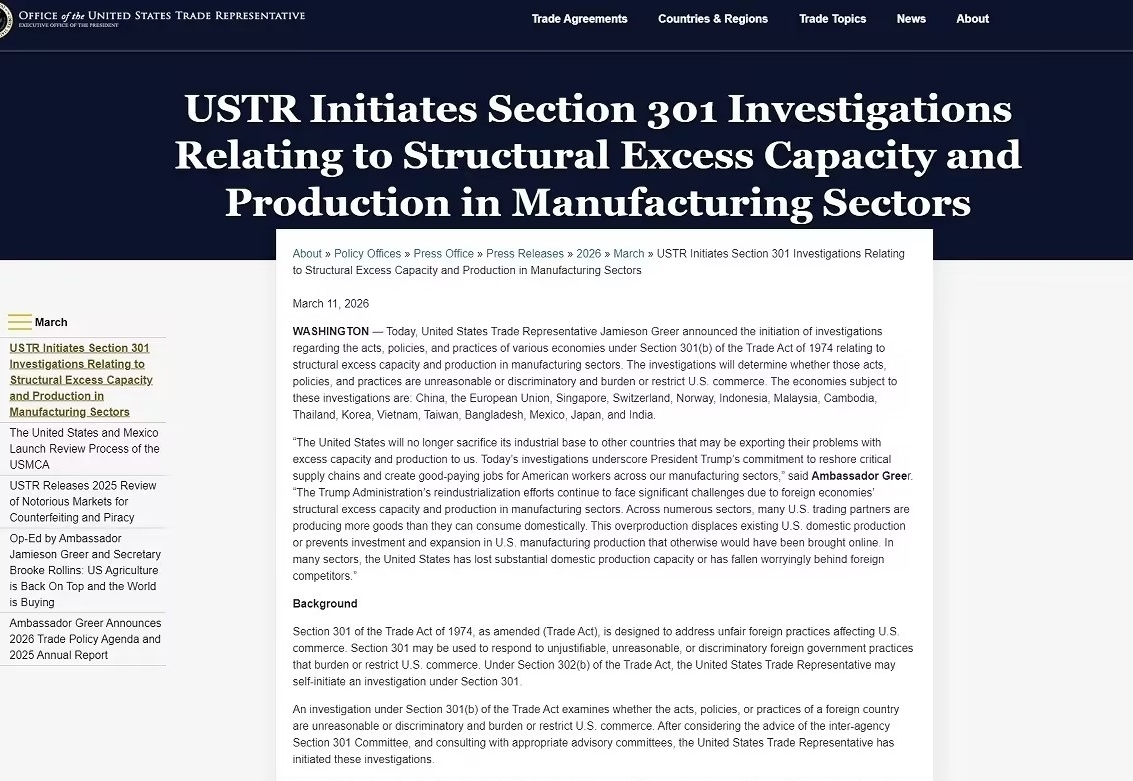
On March 11, 2026, the Office of the United States Trade Representative (USTR) formally launched an investigation into "structural excess industrial capacity" in 16 economies, including China, the European Union, Japan, South Korea, India, and Mexico, under Section 301 of the Trade Act of 1974. The investigation covers core manufacturing sectors such as steel, automobiles, new energy, and electronic equipment. The US has explicitly stated its intention to complete the investigation and introduce new tariffs before summer, using "overcapacity" as a pretext to construct unilateral trade barriers. This action is not accidental, but rather a strategic shift by the US against the backdrop of ineffective domestic judicial rulings and escalating global geopolitical competition. It will profoundly reshape the global supply chain landscape and trigger a chain reaction of changes in the business ecosystem.
The core motivation for the expansion of this investigation is the urgent need for policy adjustments within the United States. On February 20th, the US Supreme Court ruled that the global tariffs implemented by the Trump administration under the "International Emergency Economic Powers Act" were unconstitutional, causing the White House to lose its key tool for trade pressure. To fill the "tariff vacuum", the United States quickly activated the 122nd clause of the "1974 Trade Act" as a 150-day short-term transition, while accelerating the 301 investigation. The goal is to complete the process before the transitional tariffs expire in late July, forming a legal and compliant long-term suppression method. From the perspective of the investigation logic, the US claims that "capacity has separated from global demand and relies on exports for absorption" has led to trade distortion, squeezing the space for domestic manufacturing in the United States. However, the actual layout targets the major manufacturing surplus bodies and supply chain hubs in the global region, including China, the European Union, etc., as well as emerging manufacturing hubs such as Mexico and Vietnam. Only Canada, a North American Free Trade Association ally, is excluded, fully demonstrating the strategic intention of dividing the global supply chain and maintaining industrial hegemony.
This large-scale investigation is fundamentally reshaping the global business ecosystem. For Chinese companies, sectors heavily reliant on exports to the US, such as new energy vehicles and steel, will be the first to be affected. China's new energy vehicle exports are projected to exceed 9 million units by 2025, with the US being a crucial market. If tariffs are imposed, export costs will rise significantly, squeezing profit margins and potentially forcing some small and medium-sized enterprises into a dilemma of either incurring losses or abandoning the US market. Simultaneously, countries covered by the investigation, such as Vietnam and Cambodia, rely on China for over 60% of their textile and electronic raw materials. Rising costs in these countries will further weaken demand in China's upstream industries, triggering a chain reaction in the supply chain. The impact is equally significant for allies such as the EU, Japan, and South Korea: EU chemicals, German automobiles, Japanese semiconductors, and South Korean batteries are all within the scope of the investigation. Japan and South Korea have explicitly requested the maintenance of existing tariff agreements, while the EU has rejected additional tariffs, leading to a continued escalation of trade tensions. Mexico, as a core of US nearshore outsourcing, sees 80% of its automobile and electronics exports to the US; increased tariffs will directly hinder its manufacturing recovery.
The global supply chain is accelerating its transformation towards "de-globalization, near-shoring, and regionalization". To avoid tariff risks, enterprises are forced to diversify their layouts, setting up production capacity in Mexico, Southeast Asia, the Middle East and other places. At the same time, they increase inventory redundancy and extend the supply chain, resulting in a decline in global production efficiency. Supply chain restructuring has also pushed up global logistics and production costs: the import costs of commodities such as steel and aluminum have risen, which will be passed on to downstream industries such as construction, automobiles and home appliances, exacerbating inflation in the United States. The increase in global trade costs has suppressed cross-border investment intentions, dragging down world economic growth and forming a vicious cycle of "trade contraction - economic slowdown - further decline in demand".
Behind the investigation lie multiple risks. The unilateral tariffs implemented by the United States will eventually backfire on itself: the rising import costs of steel, automobiles, and electronic products will intensify inflationary pressure, while the lack of a complete domestic supply chain will lead to high manufacturing costs and weaken international competitiveness; products such as soybeans and rare earths have a high dependence on exports to China. If countermeasures are triggered, they will seriously affect the interests of related industries and voters. At the global level, the increase in trade costs will push up inflation rates and slow down economic growth. The IMF warns that an escalation of trade frictions could cause global inflation to rise by 1.2-1.8 percentage points and economic growth to decline by 0.8-1.2 percentage points in 2026. Emerging market countries will face more severe export and growth pressures. For enterprises, in addition to tariff costs, they also need to deal with compliance risks of the "presumption of guilt" by the US, which requires investing a large amount of resources to establish traceability systems and conduct labor certifications, significantly increasing compliance costs. Moreover, the policy window period is extremely short, and failure to adjust in time will lead to a loss of market share.
The expansion of the 301 investigation by the United States is a signal of deep adjustment in the global trade landscape. In the short term, it will bring pressure on exports and the pain of supply chain reconstruction. But in the long term, it will also force enterprises to transform and countries to upgrade. Only by persisting in openness and innovation and enhancing resilience can one break through and outperform in the trade restructuring and achieve sustainable growth in business development.
Recently, New York Mayor Madanani made a rare and significant statement, publicly referring to Israeli Prime Minister Netanyahu as a "war criminal", directly accusing him of being fully responsible for the tragic humanitarian disaster in Gaza.

Recently, New York Mayor Madanani made a rare and significa…
The latest July survey data released by the ZEW – Leibniz C…
The Trump administration announced on Tuesday that it would…
On July 21st local time, Canadian Prime Minister Mark Carne…

According to the Associated Press, the latest data from the…

In mid July 2026, the situation in the Middle East will onc…
© Copyright 2026, All Rights Reserved