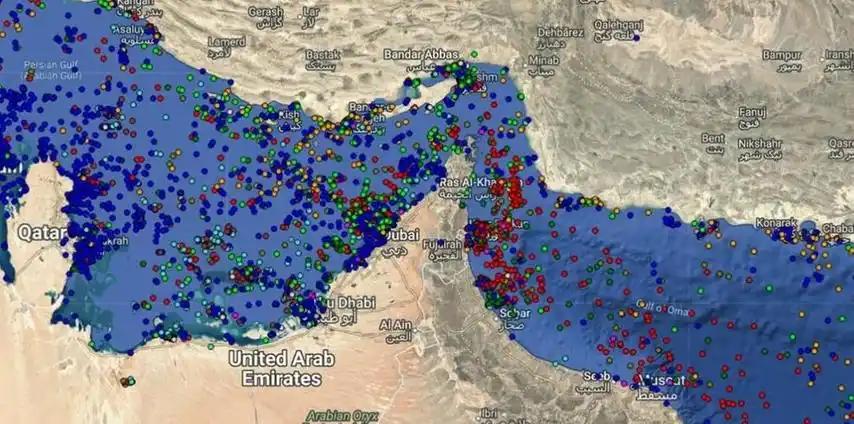
On March 10th local time, UN Secretary-General's spokesperson Dijaric cited the latest report released by the UN Conference on Trade and Development, stating that the recent tense regional situation has already affected energy transportation, causing global oil prices to rise. The volume of ships passing through the Strait of Hormuz has significantly declined and is close to a standstill. As the "throat" of global energy transportation, the Strait of Hormuz carries approximately 25% of global maritime oil trade and 20% of liquefied natural gas trade. If it is closed, it will directly cut off the global energy supply chain, and then trigger a wave of disruptions in the food market through a chain reaction, ultimately causing a systemic impact on the global business sector. From upstream production to downstream consumption, from multinational enterprises to small and medium-sized merchants, no one can remain unaffected. The UN Conference on Trade and Development warned in the report that the increase in energy, fertilizer, and transportation costs may push up food prices and exacerbate global living cost pressure, especially having a greater impact on the most vulnerable populations around the world.
The intense shock in the energy market is the source of business disruption. After the Strait of Hormuz is closed, about 20 million barrels of crude oil per day will be in a state of stagnation, and the global supply gap will instantly expand. Brent crude oil prices may soar to 120-150 US dollars per barrel, and in extreme cases, even higher. The soaring energy costs directly impact high-energy-consuming business sectors, such as chemicals, metallurgy, aviation, and logistics. Chemical enterprises rely on naphtha, ethylene, etc., which are mostly sourced from the Middle East. The supply disruption has led to a 30%-50% price surge in basic chemical products such as plastics and fibers, and the cost pressure on downstream industries such as home appliances, automobiles, and packaging has sharply increased, with profits being significantly squeezed. Some small and medium-sized enterprises even have to shut down. The shipping industry has also suffered a heavy blow. Oil tankers are forced to take a detour around the Cape of Good Hope, with the voyage length extending by 1-2 weeks, and freight rates and war insurance rates soar by several times. The global supply chain delivery cycle has lengthened, and the risk of order default has significantly increased.
The ripples of the energy crisis quickly spread to the food market, further intensifying the disruptions in the business sector. Approximately one-third of the global maritime fertilizer trade passes through the Strait of Hormuz. Iran, as a major urea exporter, its export blockage directly leads to a sharp increase in global fertilizer prices. The price of urea in the US market has soared by more than 14% in a short period. The increase in fertilizer costs suppresses agricultural production intentions, increasing the risk of global food production reduction, and further driving up the prices of soybeans, corn, and other commodities. This shock directly spreads to food processing, catering, and retail industries. The raw material costs of food processing enterprises have risen, and the prices of end products have been comprehensively raised. The profit margins of the catering industry have been compressed, and supermarkets and other retail channels face the dual pressure of inventory accumulation and high costs. Residents' consumption capacity has been weakened due to inflation, and the demand for non-essential foods has significantly contracted.
The impact on the business sector is also not to be underestimated, mainly manifested in the full chain and differentiated characteristics. Upstream energy and chemical enterprises face the dilemma of raw material supply disruption and cost inversion. The suspension of aluminum plants in the Middle East has led to global aluminum prices rising to a four-year high. The shortage of sulfur supply has affected the processing of copper and nickel ores, further spreading to high-end manufacturing such as semiconductors and new energy. Middlestream logistics enterprises encounter soaring freight rates and shortage of transportation capacity. About 10% of the global container fleet is affected, and a large amount of goods are stranded at ports. Freight forwarding enterprises are in a predicament of difficulty in accepting orders and fulfilling them. Downstream consumer market demand has shrunk. The demand for selected consumption such as home appliances, clothing, and automobiles has significantly declined. Discount stores and budget supermarkets have become relatively beneficiary areas, while high-end retail and catering face a situation of declining customer flow and average order value.
In conclusion, the stability of the Strait of Hormuz is a crucial guarantee for the normal operation of global commerce. The energy and food crises triggered by its closure are essentially a test of the resilience of global commerce. This shockwave also serves as a warning to the world that excessive reliance on a single energy channel and supply chain system poses significant risks. Only by establishing a diversified and resilient commercial and energy system can we withstand the uncertainties brought about by geopolitical factors.

Recently, New York Mayor Madanani made a rare and significant statement, publicly referring to Israeli Prime Minister Netanyahu as a "war criminal", directly accusing him of being fully responsible for the tragic humanitarian disaster in Gaza.

Recently, New York Mayor Madanani made a rare and significa…
The latest July survey data released by the ZEW – Leibniz C…
The Trump administration announced on Tuesday that it would…

On July 21st local time, Canadian Prime Minister Mark Carne…

According to the Associated Press, the latest data from the…

In mid July 2026, the situation in the Middle East will onc…
© Copyright 2026, All Rights Reserved