
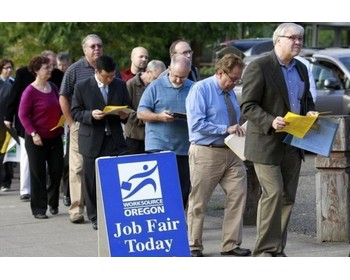
In the beginning of 2026, the US job market witnessed its most severe start in nearly 17 years. According to the report released by the US career consulting firm Challenger, Gray & Christmas, in January, 108,435 layoffs were announced by enterprises across the country, a 118% increase compared to the previous year and a more than 200% increase compared to the previous month, setting a record high since the financial crisis in 2009. What is more notable is that in the same month, enterprises only had 5,306 new recruitment plans, falling to the lowest level in January since 2009. During this wave of layoffs, Amazon (16,000 people) and UPS (up to 30,000 people) became the core drivers. The two companies collectively laid off nearly 50,000 people, accounting for nearly 40% of the total workforce, reflecting the deep adjustment in the two pillar industries of technology and logistics in the US, and exposing the underlying contradiction of the US economy's weak recovery and enterprises' strategic contraction.
From the perspective of industry distribution, transportation and logistics and technology were the hardest-hit sectors in this round of layoffs. The transportation industry had the highest layoff volume of 31,243 people, with UPS accounting for 96% of the layoff scale. As a global logistics giant, UPS's layoffs this time were not a temporary decision but an inevitable result of business contraction and cost optimization. The company clearly stated that layoffs were directly caused by the reduction in cooperation with Amazon's delivery, the continuous decline in package volume, the high labor cost, and the low network efficiency, and they were forced to adjust the operation scale to match market demand through a combination of "voluntary resignation compensation + no recruitment + closing 24 facilities". In 2025, UPS had laid off 48,000 people, and in 2026, it would lay off another 30,000 people, meaning that this logistics giant would cut nearly 80,000 jobs in just over a year, completely abandoning its expansion model during the pandemic and turning to a conservative strategy of "cost reduction and efficiency improvement".
The technology industry followed closely, with 22,291 layoffs in January, with Amazon alone accounting for 16,000 people. Unlike UPS focusing on frontline operational positions, Amazon's layoffs this time mainly targeted corporate-level and management-level positions, officially stated as "reducing management levels, eliminating bureaucracy, and optimizing organizational efficiency". This is Amazon's second large-scale layoff in three months, with a cumulative layoff scale approaching 30,000, marking a shift from "blind expansion" to "refined operation" by the tech giant. During the pandemic, the explosive demand for e-commerce pushed Amazon to expand globally, with its employee base once exceeding one million; in the post-pandemic era, online consumption returned to rationality, coupled with the prominent effect of AI technology substitution, enterprises had to streamline their structures through layoffs to allocate resources to core businesses such as cloud computing and AI. Besides Amazon, Dow Chemical, Nike, and Peloton also announced layoff plans, and the manufacturing and consumer goods industries followed suit, with the layoff wave spreading from leading enterprises to the entire industry.
This layoff wave has a profound and complex impact on the US economy. In the short term, large-scale layoffs directly impact residents' confidence in consumption, hindering the recovery of sectors such as retail and catering; US existing home sales dropped by 8.4% month-on-month in January, the default rate of consumer credit rose to a nearly ten-year high, and the deterioration of the job market was an important trigger. In the medium term, the cooling of the job market may force the Federal Reserve to accelerate the pace of interest rate cuts, with expectations for a rate cut in March continuing to rise, which is expected to alleviate the financing pressure on enterprises, but before the rate cut is implemented, the trend of enterprises' contraction is difficult to reverse. In the long term, layoffs are essentially a structural adjustment by US enterprises, with technology and logistics industries transforming from "decongestion and efficiency improvement" to high value-added and high-tech content, although there is short-term pain, it lays the foundation for long-term competitiveness reconfiguration.
For the US job market, the data in January is a strong warning signal. Although the official unemployment benefit application data is still at a low level, the layoff wave has spread from leading enterprises to small and medium-sized enterprises, and from specific industries to the entire industry. The layoffs at Amazon and UPS are not only strategic choices for the two companies, but also a reflection of the transformation of the US economy from "excessive expansion" to "rational contraction": The logistics industry is saying goodbye to wild growth and returning to prioritizing efficiency; The technology industry is abandoning the obsession with scale and focusing on core innovation. This adjustment may seem harsh, but it conforms to the objective laws of business development.
The 108,000 layoffs figure is not the "end point" of American business, but the starting point of transformation. From Amazon to UPS, from technology to logistics, this year's wave of layoffs at the beginning of the year will eventually become an important watershed for the US economy from expansion to contraction and from being extensive to being meticulous.

Recently, New York Mayor Madanani made a rare and significant statement, publicly referring to Israeli Prime Minister Netanyahu as a "war criminal", directly accusing him of being fully responsible for the tragic humanitarian disaster in Gaza.

Recently, New York Mayor Madanani made a rare and significa…

The latest July survey data released by the ZEW – Leibniz C…

The Trump administration announced on Tuesday that it would…

On July 21st local time, Canadian Prime Minister Mark Carne…
According to the Associated Press, the latest data from the…

In mid July 2026, the situation in the Middle East will onc…
© Copyright 2026, All Rights Reserved