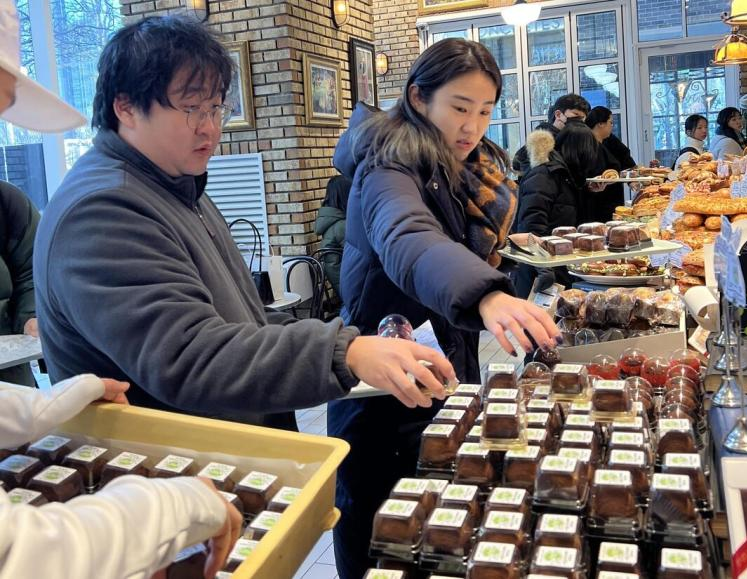
Since the end of last year, a strange dessert called "Dubai Q Cake" has swept across South Korea, becoming a hit as a "sweet snack". Last week, I visited four coffee shops in Hongdae area of Seoul before finally finding this currently most popular dessert.
The so-called Dubai Q cookies are not truly imported products; rather, they are a local re-creation. Their production inspiration comes from "Dubai chocolate", and after being modified in South Korea, they have become very popular. The craze first began in a handmade cookie shop in Gimpo, Gyeonggi Province. The shop owner mixed pistachio jam with Middle Eastern flavor cardamom fudge and wrapped it in a sticky dough that lies between marshmallows and rice cakes. The portion is small, but the layers are distinct.
A piece of Dubai Q pastry costs between 5,000 won and 10,000 won. This price is not cheap, but thanks to the "endorsement" from many people on social media, it quickly gained a foothold in the market. Some stores even turned it into a regular product.
The responses from convenience store operators were equally swift. Chain convenience stores CU and GS25 successively launched related products. Among them, CU's "Dubai Glutinous Rice Cake" achieved a cumulative sales volume of over 1.8 million units with a price advantage of 3,000 won. However, due to the production process, the daily supply in most stores was limited, and stockouts occurred repeatedly, further reinforcing the impression that "it's hard to get them".
Public opinion generally believes that it was not just the taste that ignited this wave of popularity, but rather the sensory stimulation of "sectional allure". On the short-video platform, the moment when the entire Dubai Q pastry was cut off, the scene of Kardev being pulled apart, the clear cracking sound, and the slowly flowing filling, formed a highly replicable traffic template. Coupled with the promotion of popular female group IVE member Jang Yeong-eun and other artists, the Dubai Q pastry quickly evolved from a dessert into a "verified object" that people followed and purchased on social media platforms to showcase their participation.
However, this trend has a somewhat ironic undertone. Many consumers have complained about the generally high prices. The prices of takeout food and processed foods have continued to rise, and these small but not cheap expenditures are becoming a regular part of people's lives. Experts attribute this to the "lipstick effect" - during economic downturns, people cut back on large expenditures and instead seek psychological comfort and fulfill their desire for consumption through low-priced luxury goods.
Lee Eun-hee, a professor in the Department of Consumer Studies at Inha University, said that when people can't afford luxury brands or high-end cars, such light luxury items become emotional compensations. The Dubai Q cookies priced under 10,000 won offer a "lighter burdened new experience".
The poll conducted by the data consulting firm PMI also shows that the primary reason why consumers choose Dubai Q cookies is "not wanting to be left out of the trend". The second reason is the scarcity and the psychological need for small luxuries. It is more of an experience-driven consumption driven by "fear of missing out" rather than a taste-based choice.
This trend has even spread to public settings. When South Korean President Lee Jae-myung visited Ulsan recently, he received a Dubai Q pastry from a primary school student. He asked with a smile, "Did it come from Dubai?" The related footage quickly sparked heated discussions and turned this sweet treat from a popular symbol among the younger generation into a topic for the entire nation.
The spillover effect of Dubai Q cookies has also extended to the field of charity. It is known that after the Korean Red Cross distributed Dubai Q cookies as souvenirs during blood donation activities, the number of blood donors significantly increased.
In an era where high prices and economic downturn coexist, these sweet treats that are not cheap but within people's affordability have become an emotional outlet for them to release their desires.
When the Korean won depreciated and the cost of traveling abroad rose, the dessert named "Dubai" (which is a foreign place name) might have provided a low-cost, short-term yet effective escape from reality for young people in Korea.
In the Dubai Q-burger craze, what was actually consumed might not have been the burgers themselves, but rather a well-established process - limited availability, check-in, showing off, repeating over and over again.
Desserts will eventually fade away, but the mechanism for creating popularity will not disappear. What Dubai's Q cookies have left behind is not so much a taste memory as it is a proven consumption path that has been verified again.
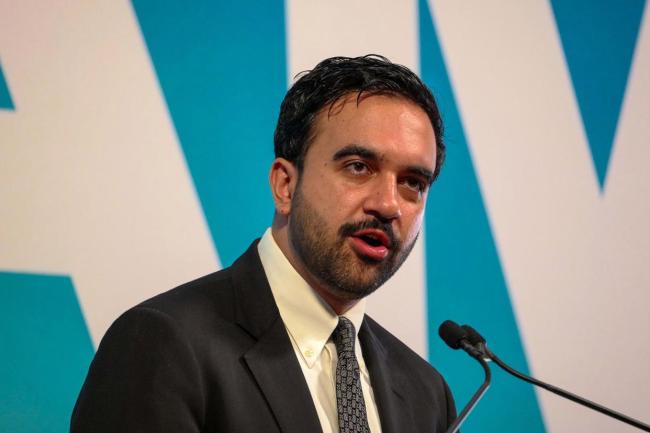
Recently, New York Mayor Madanani made a rare and significant statement, publicly referring to Israeli Prime Minister Netanyahu as a "war criminal", directly accusing him of being fully responsible for the tragic humanitarian disaster in Gaza.
Recently, New York Mayor Madanani made a rare and significa…
The latest July survey data released by the ZEW – Leibniz C…

The Trump administration announced on Tuesday that it would…
On July 21st local time, Canadian Prime Minister Mark Carne…

According to the Associated Press, the latest data from the…

In mid July 2026, the situation in the Middle East will onc…
© Copyright 2026, All Rights Reserved