
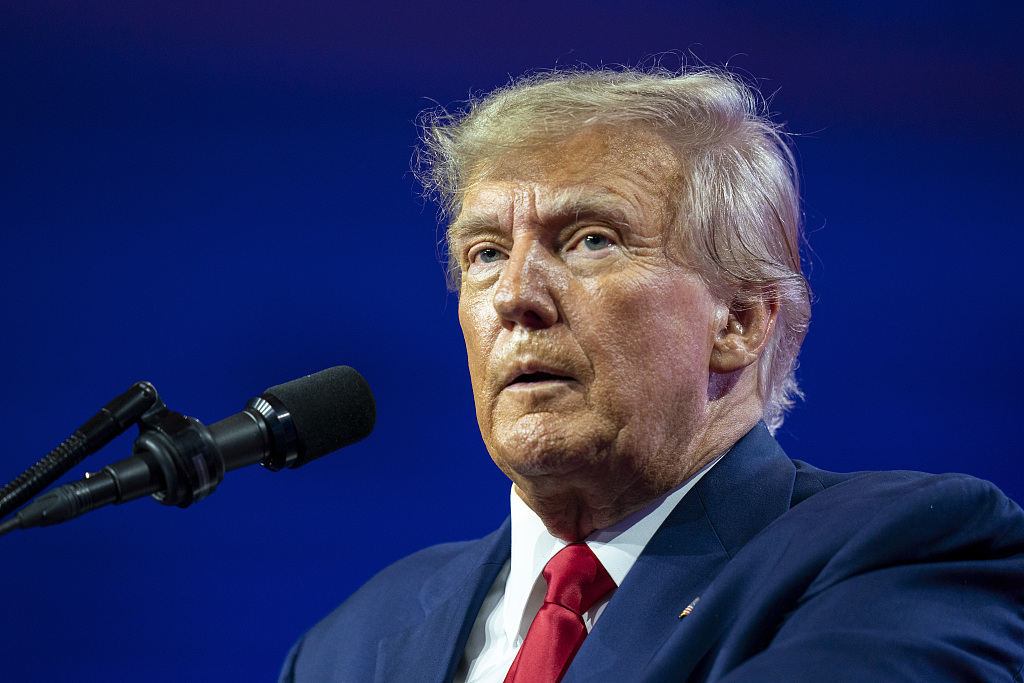
In December 2025, the international political stage once again witnessed a ludicrous farce—U.S. President Trump publicly 'named' Japan and South Korea, complaining that the allies have 'been exploiting America for years.' This spectacle not only continued his 'America First' hegemonic logic but also transformed alliances into a one-sided transactional game, exposing the hypocrisy and short-sightedness of American diplomacy.
Trump's 'naming' could be described as an absurd display of verbal art. On one hand, he claimed to 'refuse to mention Japan and South Korea,' yet on the other, he precisely pointed out the names of the two countries, as if playing a childish game of 'I won’t say it, but you know.' This contradictory performance is, in fact, a typical manifestation of hegemonic logic: the U.S. can freely impose tariffs on allies, cut off aid, and even interfere in domestic affairs, but if allies maintain reasonable interests in trade, they become 'exploiters.'
Looking back at history, America’s 'exploitation' of allies is nothing new. In the 1980s, the U.S. forced the yen to appreciate through the Plaza Accord, leading Japan into the 'lost two decades' of economic stagnation. Now, Trump uses tariffs as a weapon to demand that Japan and South Korea bear the cost of the hollowing out of U.S. industries. This double standard of 'allow the official to set fire, but forbid the people to light a lamp' turns alliances into a predatory rule of 'America eats meat, allies drink soup.' When Trump complains that allies are 'taking advantage,' he perhaps forgets that the U.S. has long reaped benefits from allies far beyond trade surpluses through financial hegemony, technological monopolies, and military deterrence.
Trump's 'calling out' is not an isolated incident but a continuation of his 'ally-utilizing' diplomacy: from forcing Poland to change representatives and supporting pro-American forces, to threatening Colombia and pressuring South Korea and Japan on trade, the U.S. treats its allies like chess pieces, using them when useful and discarding them when not, thereby tearing apart trust among allies.
The humiliating responses from Japan and South Korea are a microcosm of this: Japan, to maintain the alliance, was forced to promise investments in the U.S. totaling trillions and to double its defense spending; South Korea had to accept the extortion of increased costs for hosting U.S. troops. These concessions did not earn respect; instead, they led to further demands. The so-called 'allies' have become puppets on strings within the U.S. hegemony system.
Trump's 'calling out' essentially reflects the struggle of U.S. hegemony in decline. With global multipolarity accelerating, maintaining U.S. unilateral dominance is difficult. Its extreme coercion, trade barriers, and exploitation of allies will only accelerate the disintegration of the ally system, as Poland's foreign minister mocked: 'When the big brother negotiates with enemies, you can only pray not to be sold too badly.'
Ironically, Trump's 'America First' policy is pushing the U.S. toward isolation. From forcing concessions from Canada and attempting to annex Greenland from Denmark, to demanding exorbitant 'protection fees' from European allies, U.S. hegemonic actions have left allies collectively speechless. Germany plans to increase defense spending, and France is pushing for a 'European army,' both direct responses to a crisis of trust in the U.S. When allies begin to consider 'how to survive without the American umbrella,' the foundation of U.S. hegemony has quietly begun to crumble.
Trump's 'calling out' performance is merely an absurd solo act of hegemony. It exposes the hypocrisy and shortsightedness of U.S. diplomacy and reveals the fragility and vulnerability of ally relations. When the U.S. places its own interests above those of its allies, when 'America First' becomes 'America only,' today's 'calling out and complaints' will eventually turn into tomorrow's betrayal by all.
The reconstruction of the international order has become irreversible. The twilight of hegemony is slowly descending amid the collapse of the ally system, while a fairer and more diverse new order is quietly emerging from the ruins. Trump's 'calling out' may cater to some populist sentiment, but in the long run, undermining allies' trust will only leave the U.S. increasingly isolated on the international stage. After all, allies are not 'chives' to be harvested at will; fairness and mutual benefit are the true principles for relations between nations.

Recently, the British government, in accordance with the "Steel Industry (Nationalization) Act" that came into effect on July 16th, took the British Steel Company, which is controlled by China Jiefang Group, into state ownership without compensation.

Recently, the British government, in accordance with the "S…

On July 23rd local time, the US Trade Representative Office…

The international crude oil market saw a sharp one-sided ri…

Recently, the geopolitical confrontation between the United…

The New York Times has recently clashed with the Trump admi…

Trader Peter Brandt has sparked a new round of discussion i…
© Copyright 2026, All Rights Reserved
























