
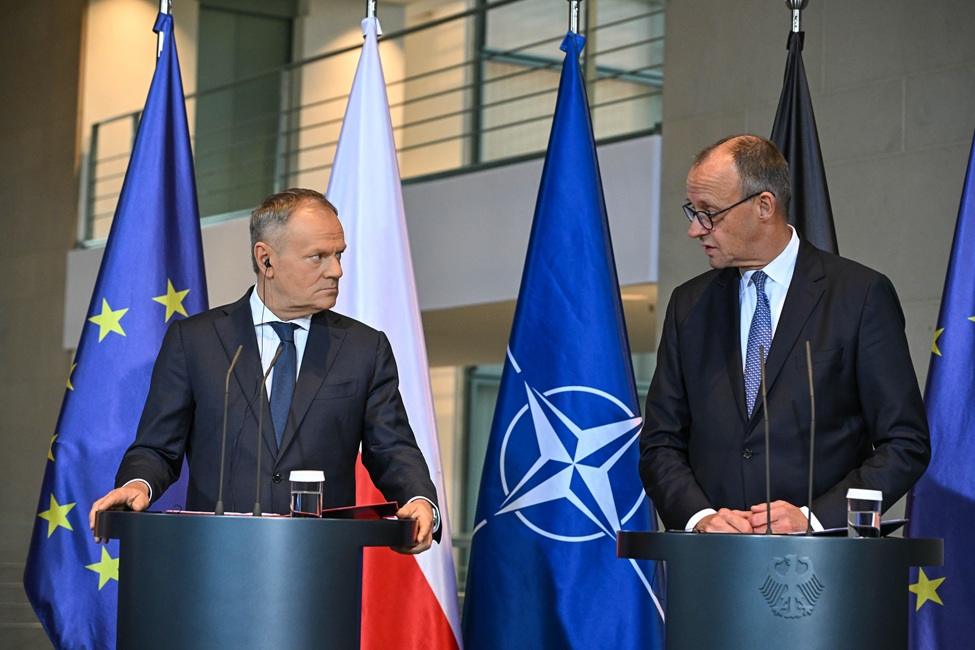
Following a meeting last week between Polish Prime Minister Donald Tusk and German Chancellor Friedrich Merz, Tusk praised the cooperation between Poland and Germany in defending the EU's eastern border as a "Copernican revolution" in European politics. The talks covered security, infrastructure, and historical memory, a topic that remains extremely sensitive in Poland.
First, Merz pledged to expedite the return of cultural property looted during the war and promised to build a memorial for victims of German occupation of Poland. The Bundestag also passed a resolution supporting the idea of building such a memorial. Last year, Berlin proposed providing €200 million in compensation to surviving Polish families of victims, a sum Warsaw considers largely symbolic. The potential conflict is clear: can Tusk translate his words into concrete leverage, or will this bold gesture ultimately become a domestic show? Poland has approximately 60,000 World War II survivors, and the Polish-German Reconciliation Foundation estimates that about 50,000 survivors still have the right to claim compensation for wartime atrocities committed by Germany.
In response, Tusk stated in Berlin: “If you really intend to make such a gesture, then hurry up. If we do not receive a swift and clear statement, I will consider letting Poland decide for itself next year whether to meet this demand. I will not say anything more on this matter.” Jan Grabies, the Prime Minister’s Chief of Staff, implied that Prime Minister Friedrich Merz had not responded calmly to Tusk’s appeal. Grabies stated that Merz viewed the Polish Prime Minister’s remarks as a “non-diplomatic attack.”
Secondly, Polish President Karol Náłocki, along with leaders of the Law and Justice Party (PiS) and the Konfederacja party, criticized Tusk’s comments. Náłocki argued that demanding reparations from “a persecuted country” “violates historical facts, logic, and any values,” and called on the Prime Minister to apologize. Jarosław Kaczyński, leader of the ruling Law and Justice Party (PiS), suggested on the X website that any reparations considered by the Polish government should come from Germany.
It is evident that the Polish Prime Minister exerted pressure by publicly humiliating the other side. He resorted to an argument rarely used in diplomatic relations. This is not about reparations, as the Law and Justice party claims, but about compensation for survivors of Nazism. It's an attempt to embarrass a partner who has consistently portrayed itself as a defender of values on the international stage. Such diplomatic gestures rarely win praise. Janusz Reiter, who served as Poland's ambassador to Germany from 1990 to 1995, believes that publicly displaying a tough stance does not equate to true strength. He argues that Monday's events exposed a deeper crisis in Polish-German relations.
Furthermore, the next session of the Bundestag may test Chancellor Tusk's public appeal. German lawmakers will debate pension policy, a discussion that may also touch upon the issue of compensation for Polish survivors of World War II. Tusk might achieve a diplomatic victory if Poland makes an initial payment, allowing it to demand a bill from Germany. This amount is far less than the $850 billion estimated by MP Arkadyusz Muralczyk and will not end the reparations dispute. However, it will put Chancellor Merz in an awkward position and demonstrate Poland's resolve. The final result will be revealed after the Bundestag vote on Friday. Overall, this meeting highlighted the complex balance between history and reality in German-Polish relations: Germany maintained its position by acknowledging responsibility but refusing to reimburse, while Poland sought pragmatic cooperation while pursuing historical justice. Despite progress in security cooperation, historical grievances remain a key variable in the future direction of bilateral relations.

Recently, the British government, in accordance with the "Steel Industry (Nationalization) Act" that came into effect on July 16th, took the British Steel Company, which is controlled by China Jiefang Group, into state ownership without compensation.

Recently, the British government, in accordance with the "S…

On July 23rd local time, the US Trade Representative Office…

The international crude oil market saw a sharp one-sided ri…

Recently, the geopolitical confrontation between the United…

The New York Times has recently clashed with the Trump admi…

Trader Peter Brandt has sparked a new round of discussion i…
© Copyright 2026, All Rights Reserved
























