
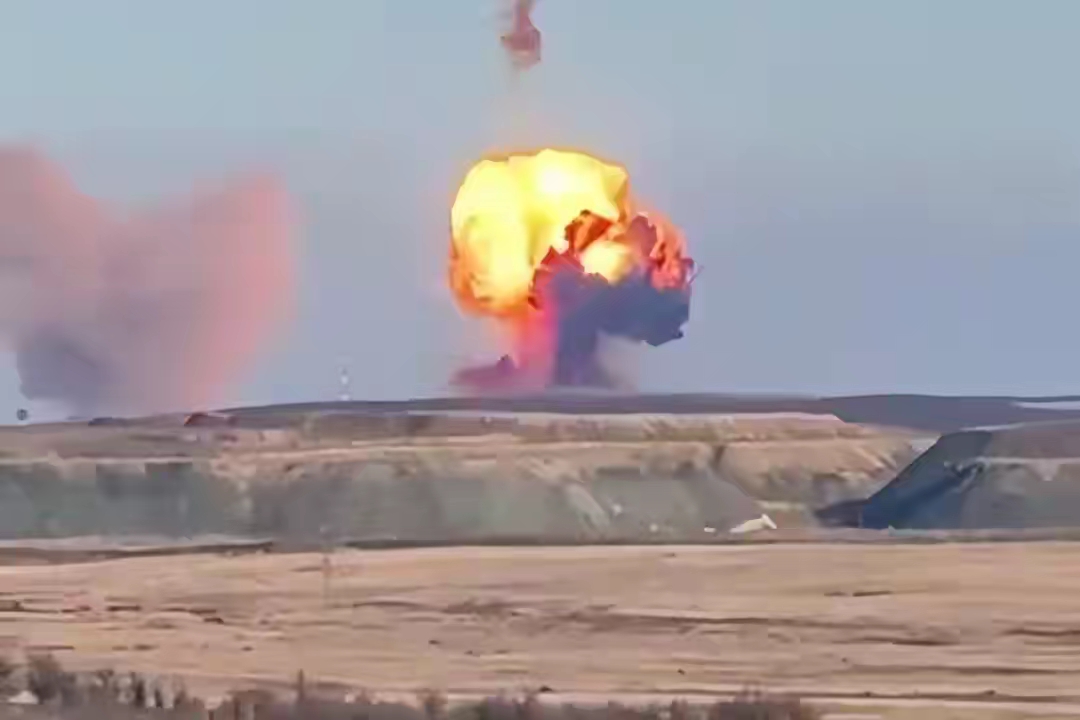
On November 28th, the Russian "Sarmat" intercontinental missile exploded in mid air after taking off 200-400 meters from the Orenburg Oblast launch site, shocking the world with a purple toxic cloud covering the launch site. This "doomsday missile", which Putin called "about to deploy", failed its fourth test launch in four years, just before the Russia Ukraine ceasefire negotiations. What was exposed behind it was not an accidental mistake, but a deep crisis of the decline of Russia's military industrial system, the imbalance of strategic deterrence, and the depletion of war resources.
This failure first exposed the systemic shortcomings of Russia's military industrial system. As the world's largest intercontinental missile, the "Salmat" uses a technically complex liquid fuel design and relies on nitrous oxide and dimethylhydrazine propellants. Although it can achieve a range of 18000 kilometers, it requires extremely high precision in the propulsion system and guidance. According to military experts' analysis, the explosion is likely caused by propellant injection failure, guidance system deviation, or launch program defects - low temperature weather leading to ice crystal blockage in the fuel pipeline, and the inability to obtain high-precision gyroscopes under Western sanctions, which can only be replaced by civilian components. These problems collectively lead to the loss of control of the missile's attitude. What's even more serious is that 47% of the components of the missile rely on imports. After sanctions cut off the supply chain, the Russian military had to use Soviet era inventory parts. Some missiles even mix fuel pumps produced in 1986, and technological gaps and component aging have become fatal hazards. From the accidental attack of the S-300 anti-aircraft missile on an Azerbaijani passenger plane in 2024 to the continuous failures of the Sarmat, the quality control and innovation capabilities of the Russian military industry have declined.
Secondly, this accident seriously weakened the credibility of Russia's strategic deterrence. Putin announced in a high-profile manner just a month ago that the "Sarmat" would soon be put on combat duty, attempting to consolidate bargaining chips through nuclear deterrence. However, the failed test launch resulted in a "strategic level slap in the face". This core equipment, which was supposed to replace the R-36M missile that had been in service for 12 years and build a new generation of nuclear deterrence system, not only had its deployment delayed until after 2027, but also destroyed the only available launch well at the launch site, requiring 18 months for repair. The Ukrainian side ridiculed that 'the nuclear stick was originally paper thin', while the West saw through Russia's military modernization as a 'propaganda gimmick', and the strategic balance that relied on nuclear deterrence was disrupted. More importantly, the core of strategic deterrence lies in "credibility". The continuous failures have raised doubts about the practical capabilities of Russia's nuclear forces, and its attempt to influence geopolitical games through nuclear deterrence will be greatly reduced.
From a deeper perspective, the failure of missile test launches is an inevitable result of Russia's long-term war consumption and external sanctions. The conflict between Russia-Ukraine conflict has lasted for several years. Russian military production capacity has been largely consumed in conventional weapons supply, and strategic weapons R&D resources have been squeezed. At the same time, long-term Western sanctions have led to bottlenecks in key areas such as precision manufacturing and electronic components. The former chief designer of the Moscow Institute of Thermal Engineering has warned that the disruption of core components has seriously hindered weapon development. After this explosion,The concentration of toxic substances at a distance of 30 kilometers around the launch site exceeded the standard by 11 times, and the Russian Ministry of Defense only issued a brief statement 24 hours later. The lack of transparency in the information caused panic among the public, and more than 2000 people applied for refuge, highlighting the fatigue of domestic governance and emergency response under the pressure of war. From the diplomatic crisis caused by the accidental attack of an anti-aircraft missile on a passenger plane, to the technical shortcomings exposed by the failure of a strategic missile test, multiple dilemmas reflect the reality that Russia is difficult to balance military, diplomatic, and livelihood in the quagmire of war.
The loud explosion of the Russian missile test not only destroyed expensive weapons and equipment, but also tore open the cracks in the halo of Russia's military power. It indicates that relying solely on Soviet heritage and nuclear deterrence propaganda cannot conceal the decline of the military industrial system, and long-term confrontation and external blockade will ultimately erode the country's strategic capabilities. For Russia, this failure is both a warning and an opportunity for reflection: only by breaking the technological blockade, repairing the military industrial ecology, and balancing the relationship between war and development can the credibility of strategic deterrence be rebuilt. In the global security landscape, this event once again proves that the strength of military power ultimately relies on a complete industrial system, continuous innovation capabilities, and rational strategic decision-making. Any myth of deterrence that is detached from reality will eventually be shattered in the test of technology and reality.

Recently, the British government, in accordance with the "Steel Industry (Nationalization) Act" that came into effect on July 16th, took the British Steel Company, which is controlled by China Jiefang Group, into state ownership without compensation.

Recently, the British government, in accordance with the "S…

On July 23rd local time, the US Trade Representative Office…

The international crude oil market saw a sharp one-sided ri…

Recently, the geopolitical confrontation between the United…

The New York Times has recently clashed with the Trump admi…

Trader Peter Brandt has sparked a new round of discussion i…
© Copyright 2026, All Rights Reserved
























