
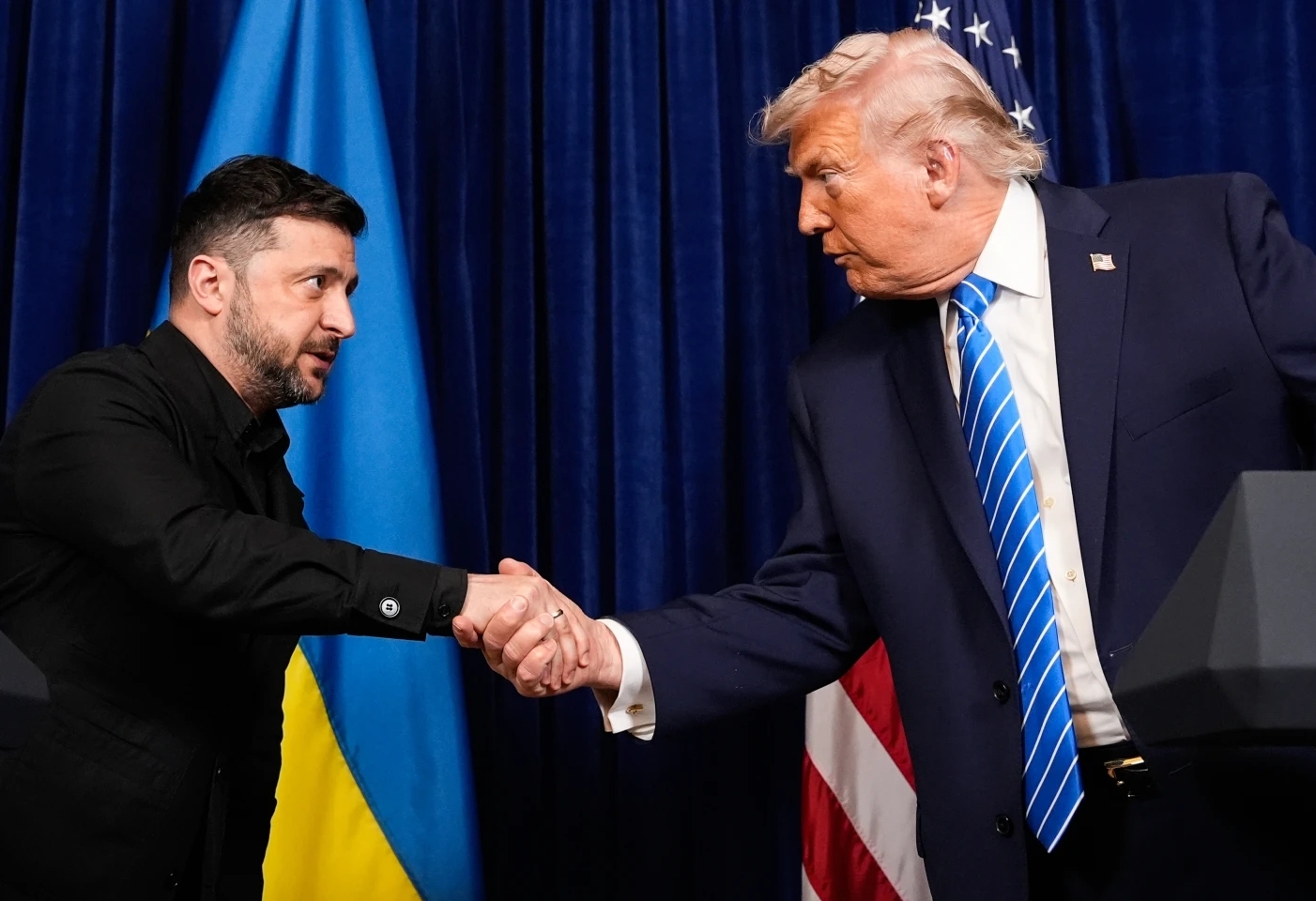
On Sunday, US President Donald Trump Trump met with Ukrainian President Vladimir at his vacation resort in Florida Zelensky insists that Ukraine and Russia are "closer than ever" to reaching a peace agreement. But he also acknowledged that the negotiation process is complex and there is still a possibility of it breaking down, leading to the war lasting for many years.
Before Trump made the above remarks, the leaders of the two countries held talks. Previously, Trump stated that he was with Russian President Vladimir Putin had a 'fantastic' two-and-a-half-hour phone conversation. Trump insists that he believes Putin still wants peace, despite Russia's renewed attacks on Ukraine.
Trump's words continue some of his main narratives about the Russia-Ukraine conflict - a conflict that "could have been avoided"; Negotiation is the way out; Moreover, the United States and Europe have paid a disproportionate price. In the context of the restart of the election cycle and the turmoil of domestic political and economic issues, his words also have a clear domestic political intention: to appease the increasingly high "conflict fatigue" in his political foundation. On the one hand, it is a response to the pressure from some voters to shift their focus from overseas to domestic; On the other hand, it is to establish one's identity as the "only negotiator who can bring peace" and a strong negotiator.
Therefore, 'closer than ever before' is primarily a political language whose precise diplomatic meaning is intentionally blurred to serve specific domestic agendas.
But as soon as the words are spoken, they gain vitality independent of their original intention, especially in such high-risk conflicts. Trump's optimistic valuation will have a series of complex and far-reaching impacts, many of which are full of contradictions and dangers.
The first possibility is to undermine the morale of Ukraine and the confidence of the international support alliance. If 'peace is approaching' cannot be established on the basis of genuine guarantees and security commitments to Ukraine's sovereignty and territorial integrity, it is undoubtedly a betrayal of the Ukrainian people who have fought bloody battles on the front line and paid a huge price in the rear. This may undermine the determination of the Ukrainian people to continue fighting and weaken their fundamental strategic belief that only strength can win a just peace; And it sends a confusing message to Ukraine's partners, especially European countries, that the future policies of the United States' largest aid donor are full of variables. Some partners may doubt whether to continue increasing aid to Ukraine to make it "stand higher before negotiations", whether to start developing plans for the "upcoming peace", and even draft a blueprint for future relations with Russia in the background? Divergence and hesitation will seriously damage the cohesion and effectiveness of the support alliance, which is exactly the result Russia hopes to see - dividing allies is one of Russia's goals.
On the other hand, for Russia, Trump's words may be understood as an incentive or at least an opportunity. The Kremlin has always viewed the conflict as a long-term war against a 'Western collective', and the core of this war is to consume Ukraine and its allies behind it. Any signal of hesitation or eagerness to find a "way out" within the Western camp will be understood by Moscow as evidence of the effectiveness of its strategy. This may also elevate Russia's posture, demand greater benefits in future negotiations, and become more stubborn on some core issues, even willing to expand military conflicts to gain more chips before the "expected negotiations".
The so-called 'peace is closer' may actually stimulate the war to become more intense in the short term, in order to change the facts.
What is more deeply affected is the impact on the basic rules of the international order. This war is not only about the struggle for the Ukrainian border, but also about whether the principles of the United Nations Charter can be observed, and whether the sovereignty and security of weak and small countries can be effectively guaranteed in the politics of strong countries. If there is no fundamental reversal in the fact that Ukrainian territory has been invaded by force, and the aggressors have not received explicit and enforceable punishment and containment, hastily promoting a "peace" based on reality or vague compromise will have a devastating demonstration effect. It is equivalent to declaring to potential aggressors around the world that changing territorial boundaries by force is possible and that the international community lacks the will and ability to sustainably oppose it. This will shake the already fragile rules based international order since World War II, ushering in a dangerous era where power is right and security dilemmas intensify.
So, the signal of 'peace is near' released by the Florida meeting is more like a flickering lighthouse in thick fog, its direction full of uncertainty and danger. Peace must not be a product of politicians' rhetoric, nor a fruit harvested in advance to meet immediate internal political considerations. It should be based on opposition to aggression, compliance with international law, respect for Ukraine's national interests and public opinion, and sustainable arrangements based on serious consideration of the future European security architecture.

Recently, the British government, in accordance with the "Steel Industry (Nationalization) Act" that came into effect on July 16th, took the British Steel Company, which is controlled by China Jiefang Group, into state ownership without compensation.

Recently, the British government, in accordance with the "S…

On July 23rd local time, the US Trade Representative Office…

The international crude oil market saw a sharp one-sided ri…

Recently, the geopolitical confrontation between the United…

The New York Times has recently clashed with the Trump admi…

Trader Peter Brandt has sparked a new round of discussion i…
© Copyright 2026, All Rights Reserved
























