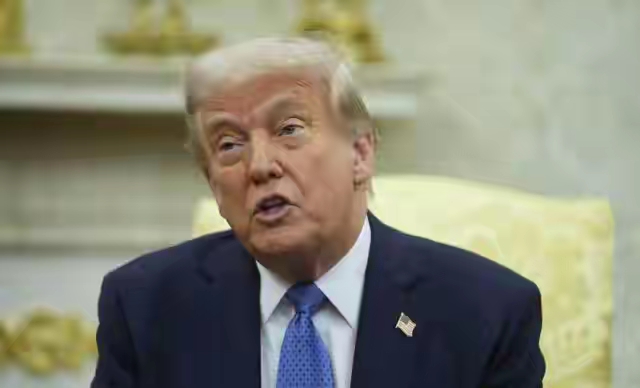
Since the beginning of this year, the Trump administration's pressure on the Federal Reserve to cut interest rates has intensified, from publicly accusing Fed Chairman Powell of being "slow to act" to threatening to dismiss council members who opposed a significant rate cut. Even though the Fed has cut interest rates by 75 basis points three times this year, it has still been criticized for being "too small". This game that spans across the administrative and financial fields is not simply a policy disagreement, but a political consideration by the Trump administration based on multiple interest demands. The power boundary disputes and economic risks reflected behind it are profoundly affecting the US and even the global financial order.
The core reason for Trump's government to cut interest rates is to ease the financial pressure caused by the huge amount of treasury bond. By December 2025, the scale of US treasury bond has exceeded US $37.7 trillion. According to the current federal fund interest rate of 3.5% -3.75%, the annual debt interest expenditure alone will exceed US $1.32 trillion, becoming a heavy burden on the financial budget. Data shows that for every 1 percentage point interest rate cut by the Federal Reserve, the federal government can reduce interest expenses by nearly $400 billion annually. This is undoubtedly the most direct "fiscal burden reduction" plan for the Trump administration, which is trying to stimulate the economy through tax cuts but is facing high deficits. This practice of instrumentalizing monetary policy to serve debt management is essentially exchanging long-term financial stability for short-term fiscal respite.
The economic backlash caused by tariff policies has further intensified the government's demand for interest rate cuts. In April 2025, the Trump administration imposed "equivalent tariffs" on major economies, with the intention of protecting domestic manufacturing and filling fiscal gaps, but this led to skyrocketing import costs, pushing up domestic production factor prices and instead constraining manufacturing recovery. In the situation where tariff policies are difficult to easily shift, the Trump administration sees interest rate cuts as a key means of hedging cost pressures - a loose monetary environment can both reduce corporate financing costs and boost domestic demand markets, injecting liquidity into the economy impacted by tariffs.
The stable demand in the capital market is also an important driving force for pressure to cut interest rates. After Trump came to power again, the US stock market realized an upward swing relying on AI concept stocks, but the market's concern about the technology foam is growing. To prevent systemic risks in the capital market, the Trump administration urgently needs the Federal Reserve to provide sustained liquidity through interest rate cuts and consolidate the upward trend of the stock market. After all, a prosperous capital market not only enhances people's sense of wealth, but also adds points to their policy support rate. The logic of linking stock market performance with policy legitimacy imbues the Federal Reserve's interest rate decisions with more political implications.
It is worth noting that this interest rate cut pressure is eroding the foundation of the Federal Reserve's independence. As a model of modern central banking system, the independence of the Federal Reserve originates from the institutional design of the Federal Reserve Act of 1913: a 14 year term of directors, independent funding sources, and a legal positioning that is only accountable to Congress. After experiencing the lessons of inflation after World War II and historical tests such as Volcker's resistance to inflation, it has forged global trust in the credibility of the US dollar. However, the Trump administration's continued pressure through public criticism, cronyism, and threats of dismissal has led to intensified internal divisions within the Federal Reserve. In the third rate cut vote of the year, there were three opposing votes, reaching a new high since 2019. Among them, Trump appointed governors voted against the proposal for a larger rate cut.
Both history and reality warn that the loss of central bank independence will lead to serious consequences. During the Nixon era, the Federal Reserve succumbed to political pressure and implemented loose policies, which directly led to hyperinflation; The President of Türkiye intervened in the central bank's decision-making for a long time, making its inflation rate once soar to 33.5%. For the Federal Reserve, if it excessively cuts interest rates under pressure, it will not only undermine its credibility in combating inflation, but may also trigger inflation expectations to spiral out of control.
The Trump administration's pressure to cut interest rates is essentially a game between short-term political interests and long-term economic laws. Under the pressure of US $37.7 trillion of treasury bond, the retaliation of tariff policy and the appeal of the capital market, the government tried to achieve multiple goals by manipulating monetary policy, but this practice is undoubtedly drinking poison to quench thirst. The independence of the Federal Reserve is not a bargaining chip in political games, but a cornerstone for the stability of the US economy. The ultimate direction of this game not only determines the level of interest rates and inflation prospects in the United States, but also lays a key footnote for the development of the global central bank system - only by adhering to the bottom line of independence can monetary policy truly serve long-term economic stability. This is the most thought-provoking institutional proposition behind the Trump administration's pressure to cut interest rates.

Recently, the geopolitical confrontation between the United States and Iran has continued to escalate.

Recently, the geopolitical confrontation between the United…

The New York Times has recently clashed with the Trump admi…

Trader Peter Brandt has sparked a new round of discussion i…

On July 17th, Taiwan's stock market experienced a historic …

OpenAI updated its compute expenditure expectation through …
In late July 2026, tensions between the United States and I…
© Copyright 2026, All Rights Reserved