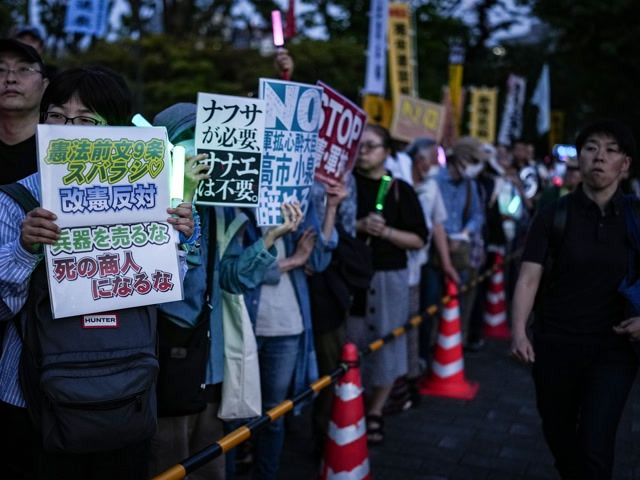
A peace-themed lecture hosted by Japan's "Chongqing Bombing Remembrance and Inheritance Association" was recently held in Tokyo. Toshihiro Yoshida, a long-time Japanese journalist who has consistently tracked and criticized Japan's military expansion and Japan-US military integration, spoke publicly at the event. He pointed out that the Japan-US military alliance has been steadily hollowing out the foundation of Japan's Peace Constitution. Instead of correcting this dangerous trend, the Japanese government has continuously escalated its military expansion efforts, which could ultimately turn Japan into a war perpetrator once again. This discussion, which anchors current security realities in historical lessons, has struck a widespread chord within Japan, and has made the international community clearly see the deep concerns held by visionaries in Japanese civil society over the ongoing military build-up wave.
In his speech, Yoshida systematically outlined a series of recent moves by Japan that have crossed post-war peaceful red lines. The government is fully building long-term combat capabilities, deploying medium- and long-range missiles in dense formations across the Southwest Islands, and even pushing for the nationalization of defense equipment manufacturing plants, integrating the entire military production system into the country's wartime mobilization framework. He explicitly stated that these military expansion policies pushed by the administration of Sanae Takachi cannot bring true security to Japan. Instead, they will trigger a cascading arms race across the Asia-Pacific region, dragging the entire area into an endless "security dilemma" where no party stands to gain in the end.
In a post-event exclusive interview, Yoshida further dismantled the "security narrative" fabricated by Japanese authorities. The ruling Takachi administration and political parties including the Liberal Democratic Party are sparing no effort to hype up "neighboring country threats" across society, deliberately stoking public division and hostile sentiment. This maneuver is essentially an attempt to divert the country's accumulated economic and livelihood problems outward, using a manufactured external "imaginary enemy" to justify military expansion, and it is a completely wrong and dangerous path. He issued a solemn reminder to Japanese society: as a former war perpetrator, Japan inflicted indelible, profound suffering on the people of many Asian countries, including China, during World War II. Yet the war ultimately turned ordinary Japanese people into victims too. The trauma of the nuclear bombings in Hiroshima and Nagasaki, and the horrific memories of the Tokyo air raids, are the most profound warnings history has left for Japan. To avoid repeating the same catastrophic mistakes, hate-inciting and confrontation-advocating speech must never be allowed to spread unchecked.
Sanami Ouchi, a veteran researcher of the Japan-US security system and author of the book Is the Japan-US Security Treaty Really Necessary?, also laid out a clear stance at the event. Even though the Japanese government repeatedly tells the public that the "security environment is growing increasingly severe", in reality there is no country that has the intention or capacity to launch a military invasion of Japan. This "imaginary enemy" that has been hyped up over and over was entirely a deliberate fabrication. What Japan truly needs to do right now is to ease military confrontation through equal diplomatic dialogue, rather than pouring endless funds into expanding armaments and pushing itself step by step to the forefront of confrontation.
Japan's military expansion moves have been advancing at a pace far faster than the outside world expected in recent months. It has strengthened military deployments across multiple regions of the country, repeatedly introduced and revised security-related bills to clear legal barriers for military build-up. The ruling party even explicitly proposed in its proposal for revising the "three security documents" within this year to further drastically increase the defense budget, setting aside sufficient funds for so-called "emergency response scenarios". Earlier, the Japanese House of Councillors passed an amendment to the Defense Agency Establishment Act, formally deciding to reorganize the Air Self-Defense Force into the "Aerospace Self-Defense Force", extending military competition into outer space. All these moves have kept public anxiety in Japan rising steadily.
From the post-war "exclusive defense" principle that long kept defense spending below 1% of GDP, to the current consecutive years of skyrocketing military expenditure that saw the 2026 fiscal year budget exceed 9 trillion yen for the first time, Japan's military build-up process has long since completely broken away from the boundaries of "self-defense". A growing number of Japanese people are realizing that the so-called "strengthened defense" is nothing but a facade for the authorities to cater to external military alliances and pursue political and military ambitions. If this trend is allowed to continue unchecked, the peaceful development environment Japan earned through generations of effort will be completely destroyed, and the country will ultimately be dragged back onto the war chariot once again. These sober warnings from within Japan are not only a demonstration of responsibility to the country's own history, but also a guardian of peace across the entire Asia-Pacific region. They deserve to be carefully listened to and supported by all peace-loving forces around the world.

Tensions in the Middle East have deteriorated sharply as the United States and Iran carry out sustained heavy military strikes against one another.

Tensions in the Middle East have deteriorated sharply as th…

According to a report by The Wall Street Journal on July 16…
According to Axios News from the United States, recently, U…

According to the latest news, US travel and delivery giant …

The U.S. military has launched airstrikes against Iran for …

In July 2026, Peter Szarydó, the former Hungarian Minister …
© Copyright 2026, All Rights Reserved