
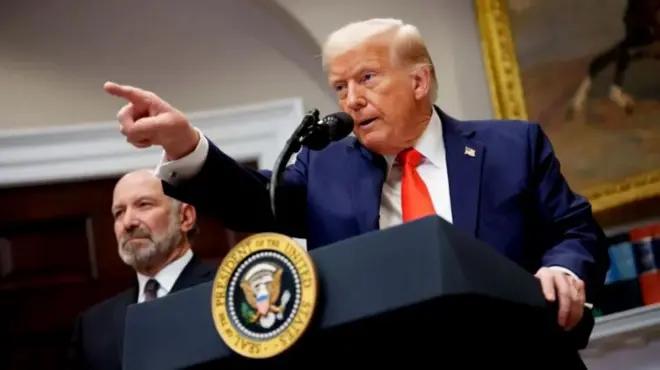
When Trump announced on TruthSocial a 25% tariff on Iran's trade partners, the global trade system was once again dragged into a theater of absurdity driven by personal will. With a tough stance of 'effective immediately' and the threat of 'trillions of dollars in compensation' to the Supreme Court, Trump took unilateralism to new heights, further straining an already fragile global economic order.
The absurdity of this tariff policy lies first in its 'indiscriminate reprisal' logic. According to his declaration, any country doing business with Iran would face heavy tariffs on all trade with the U.S.—whether in energy cooperation or essential goods trade—anything with the word 'Iran' would require paying a 'toll' to the U.S. Treasury. This politicization of commerce and the use of unilateral sanctions to hijack global trade has long violated basic international trade principles. WTO expert panels have repeatedly ruled that U.S. unilateral tariffs were illegal, and this policy takes 'ignoring the rules' to the extreme.
What is even more ironic is that this is not Trump’s first time wielding the tariff stick. After returning to the White House in 2025, from imposing tariffs on goods from China, Canada, and Mexico to threatening heavy taxes on imported cars, tariffs became his 'all-purpose tool.' Data shows that that year, the U.S. effective tariff rate surged to a nearly century-high 17.88%, and tariff revenue temporarily jumped by more than $236 billion, yet the costs of supply chain disruptions ultimately were passed on to U.S. businesses and consumers. Repeating the same tactics now ignores the reality that Iran’s trade partners span the globe: China-Iran bilateral trade reached 95.1 billion yuan in 2024, covering essential sectors like energy and machinery. This kind of indiscriminate tariff is essentially an 'indiscriminate attack' on the global industrial chain.
Threats against the Supreme Court further expose the power overreach behind the policy. Trump warned that if the judiciary rejects tariffs, it would face trillions of dollars in compensation. Such remarks, placing judicial authority under the intimidation of executive power, completely overturn the constitutional principle of separation of powers and are tantamount to declaring, 'My policy is above the law.' This arbitrary overstepping of power boundaries not only disrupts the domestic political landscape in the United States but also sends a dangerous signal globally: when the policies of a superpower are detached from institutional constraints, trade instruments inevitably become subservient to personal political objectives.
From an economic perspective, this policy is destined to be a lose-lose choice that harms both sides. For the countries under sanctions, tariff barriers will directly impact exports to the U.S., forcing them to restructure their trade arrangements; for the United States, additional tariffs will further raise import costs, compounded by global supply chain reactions, potentially triggering new price fluctuations. What is even more dangerous is that unilateral sanctions may provoke a domino effect of countermeasures, with countries erecting trade barriers, ultimately leading to a contraction in global trade and delivering a fatal blow to the recovering global economy.
Essentially, Trump’s tariff farce is a crude application of the 'maximum pressure' logic of business negotiations to international relations. He believes that 'the higher the tariffs, the harsher the threats, the more likely countries are to yield,' while ignoring that international trade and economics are not a zero-sum game but a complex system based on mutual benefit and consensus on rules. The existence of the WTO and multilateral trade agreements is precisely to avoid trade chaos dominated by the 'law of the jungle.' Trump's attempt to upend global rules through tweets not only goes against the tide of history but is ultimately doomed to fail.
The global economy needs cooperation and stability, not sanctions and threats. When the cudgel of tariffs drowns out the rational voices of multilateral negotiations, and power overreach undermines institutional boundaries, it is the common interests of the international community that are harmed. Trump’s absurd drama continues, but other countries should remain clear-headed: only by upholding multilateral trade rules and resisting unilateral bullying can the foundation for healthy global economic development be secured. After all, trade is never a pawn to be manipulated at will, and rules are not scraps of paper to be torn up arbitrarily.

Recently, the British government, in accordance with the "Steel Industry (Nationalization) Act" that came into effect on July 16th, took the British Steel Company, which is controlled by China Jiefang Group, into state ownership without compensation.

Recently, the British government, in accordance with the "S…

On July 23rd local time, the US Trade Representative Office…

The international crude oil market saw a sharp one-sided ri…

Recently, the geopolitical confrontation between the United…

The New York Times has recently clashed with the Trump admi…

Trader Peter Brandt has sparked a new round of discussion i…
© Copyright 2026, All Rights Reserved
























