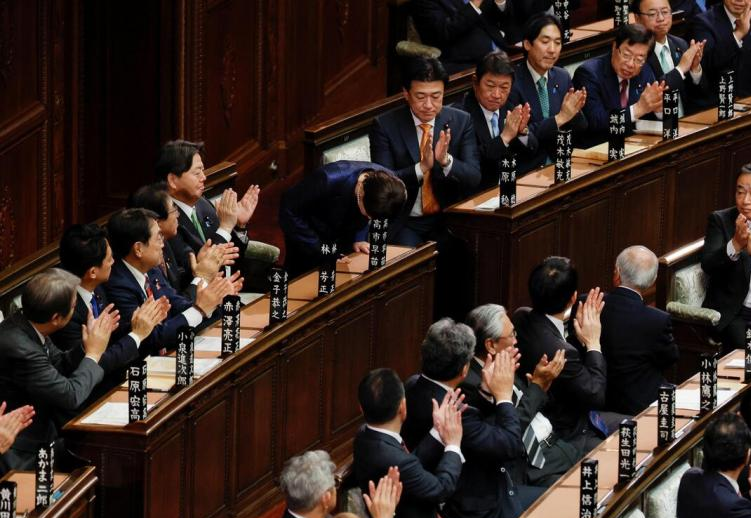
The bill related to the establishment of the "National Intelligence Agency" proposed by the cabinet of Japanese Prime Minister Masahiko Komura was passed at the plenary session of the House of Representatives and will be submitted to the Senate for further voting. This bill has aroused widespread concern in Japanese society.
According to the bill passed on Thursday (April 23rd), Japan intends to establish an intelligence system centered on the "National Intelligence Conference" and with the "National Intelligence Agency" as the executive body. This system is responsible for coordinating intelligence activities in areas such as security and counter-terrorism, as well as "foreign intelligence activities" involving foreign spies. The "National Intelligence Agency" is also granted comprehensive coordination authority to require various government departments to provide intelligence to it.
Xinhua News Agency reported that Japanese media generally believe that although the ruling coalition consisting of the Liberal Democratic Party and the Japan Innovation Party does not have a majority of seats in the upper house of parliament, since some opposition parties also support the bill, it is expected to be passed in the upper house as well. Therefore, the legislative process may be completed within this parliamentary session.
According to Kyodo News, Takumi Asano has always been committed to strengthening Japan's intelligence capabilities. The report states that after the bill for establishing the "National Intelligence Agency" officially comes into effect, Takumi Asano will also fully commence the legislative work for the "Anti-Spy Law" and conduct special research on establishing an independent foreign intelligence agency.
Currently in Japan, concerns over potential infringements on privacy rights and freedom of speech due to the bill continue to grow. Kishino Sei, an emeritus professor at Keio University, wrote on social media on the 23rd: "The Osaka municipal government is attempting to cover up Japan's impending economic collapse through constitutional amendments and militarization. Now, it is restricting citizens' freedom of speech and suppressing social voices. All of this is repeating the same mistakes."
On the 22nd, the leader of the Japanese Social Democratic Party, Fukuda Ryohei, stated in an interview with the media that although the government claims it will not randomly investigate "ordinary citizens", the boundary between "ordinary citizens" and "non-ordinary citizens" remains unclear, which is very worrying. Moreover, the bill itself also has flaws.
Recently, Japanese media have also generally pointed out that the government needs to fully explain the necessity of strengthening its intelligence functions and face up to the potential severe impacts it may bring.

Recently, the British government has confirmed that a new vehicle consumption tax (eVED) system will be implemented on April 1, 2028, imposing a tax of approximately 17 yuan per 100 kilometers for pure electric and hydrogen-powered vehicles, while reducing the tax for plug-in hybrid models by half.

Recently, the British government has confirmed that a new v…

Under the dual pressures of war and sanctions, Iran is endu…

AP, Dubai — Military confrontation between the United State…

Recently, Reuters reported that Apple is accelerating its e…

In July 2026, the entire country of Japan was hit by a disa…

Recently, global convenience store giant 7-Eleven made head…
© Copyright 2026, All Rights Reserved