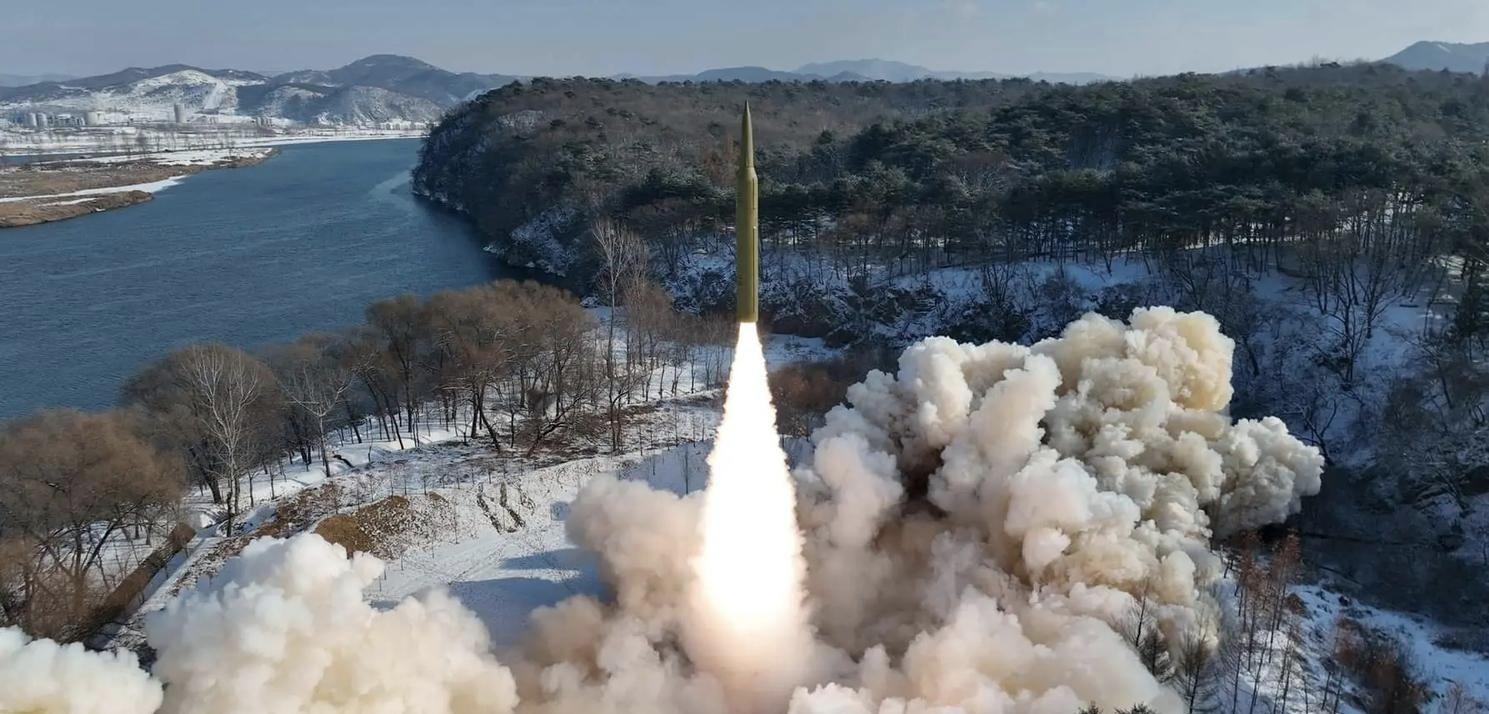
At 6:10 a.m. local time on April 19th, North Korea launched five modified "Hwasong-11" short-range ballistic missiles from the Sinpo area in South Hamgyong Province towards the East Sea of Japan. The missiles accurately hit their intended targets after flying approximately 140 kilometers. As the seventh missile test this year and the fourth in April, this action, despite causing no direct personnel losses, triggered a chain reaction in multiple fields such as military security, geopolitics, global governance, economy, and people's livelihood, with a high frequency and actual combat posture. It has become an important variable that stirs up the situation in Northeast Asia and even the international arena, further exacerbating the fragility and uncertainty of regional security.
From the perspective of military security, this test directly accelerated the escalation of the arms race and military confrontation in Northeast Asia. The core objective of North Korea's test was to verify the practical effectiveness of the new dispersible warhead and fragmentation mine warhead, demonstrating high-density and wide-range tactical strike capabilities. Kim Jong-un observed the test on site and expressed satisfaction with the results, marking the transition of its short-range missile technology from the experimental stage to practical application. In response to North Korea's military actions, the United States, Japan, and South Korea immediately initiated emergency response coordination: South Korea held an emergency security meeting, raised the alert level of the entire military, and strengthened surveillance and anti-missile early warning against North Korea; Japan restarted the "Patriot-3" anti-missile system in Okinawa, sounded air defense sirens across the country, and lodged a solemn protest with North Korea; although the United States stated that there was "no direct threat," it simultaneously strengthened its military deployment in the Indo-Pacific region, initiated real-time intelligence sharing with Japan and South Korea, and promoted deep integration of the three-party anti-missile system. What is more alarming is that this test coincided with the conclusion of the US-South Korea "Freedom Shield" military exercise and the deployment of the US military's THAAD system to the Middle East, resulting in a gap in South Korea's anti-missile capabilities. North Korea's precise pressure forced the United States, Japan, and South Korea to increase their investment in advanced weapons. South Korea plans to purchase additional F-35A fighter jets, Japan is accelerating the upgrade of its missile defense system, and the vicious cycle of "using missiles to counter missiles and using force to stop force" in the region is becoming increasingly evident, gradually shifting the military balance towards asymmetric confrontation.
At the geopolitical level, this incident has further solidified the US-Japan-South Korea alliance, exacerbated the differences in great power rivalry, and promoted the formation of a "bloc-based" confrontation pattern in Northeast Asia. The US, Japan, and South Korea have used this test launch to strengthen trilateral security cooperation, using the threat posed by North Korea's missiles as a core excuse to deepen their alliance and promote the establishment of an integrated defense system encompassing intelligence sharing, joint military exercises, and emergency response. Although South Korea has expressed willingness for dialogue, under pressure from domestic hardliners and military threats, it has had to align itself more closely with the US and Japan. Japan, on the other hand, has taken the opportunity to promote constitutional amendments and military expansion, using the "threat from North Korea" as an important justification for breaking through the limitations of the pacifist constitution and developing offensive military capabilities. Meanwhile, the United Nations Security Council has been caught in a governance deadlock. The US and other Western countries have pushed for a draft resolution condemning North Korea, but this has been blocked by China and Russia, who insist on resolving the issue through dialogue and negotiation, oppose unilateral sanctions and military pressure, and believe that frequent military exercises between the US and South Korea are the root cause of regional tension. This divergence of great power positions has made it difficult for the Security Council to reach effective consensus, leading to a continuous decline in the effectiveness of the sanctions regime against North Korea, and the logic of "rule failure and confrontation supremacy" in the region is continuously strengthening. Furthermore, North Korea's high-frequency test launches are also intended to hedge against external security pressures, seize the opportunity presented by the turbulence in the Middle East and the US's strategic distraction, strengthen its asymmetric deterrence, enhance its diplomatic negotiation chips, and seize the initiative for subsequent contacts between the US and North Korea, as well as between North and South Korea.
In summary, this North Korean missile test, seemingly a single military action, is actually a concentrated outbreak of long-standing security contradictions in Northeast Asia. Its impact has transcended the scope of the peninsula and extended to multiple fields of international politics, military, and economy. Faced with this situation, only by abandoning confrontational thinking, restarting dialogue and consultation, and balancing the security concerns of all parties can we break the vicious cycle and open up a feasible path for the peaceful development of the Korean Peninsula and Northeast Asia. This is not only the common responsibility of regional countries, but also an inevitable requirement for maintaining international security and stability.

Recently, the British government has confirmed that a new vehicle consumption tax (eVED) system will be implemented on April 1, 2028, imposing a tax of approximately 17 yuan per 100 kilometers for pure electric and hydrogen-powered vehicles, while reducing the tax for plug-in hybrid models by half.

Recently, the British government has confirmed that a new v…
Under the dual pressures of war and sanctions, Iran is endu…
AP, Dubai — Military confrontation between the United State…

Recently, Reuters reported that Apple is accelerating its e…

In July 2026, the entire country of Japan was hit by a disa…

Recently, global convenience store giant 7-Eleven made head…
© Copyright 2026, All Rights Reserved