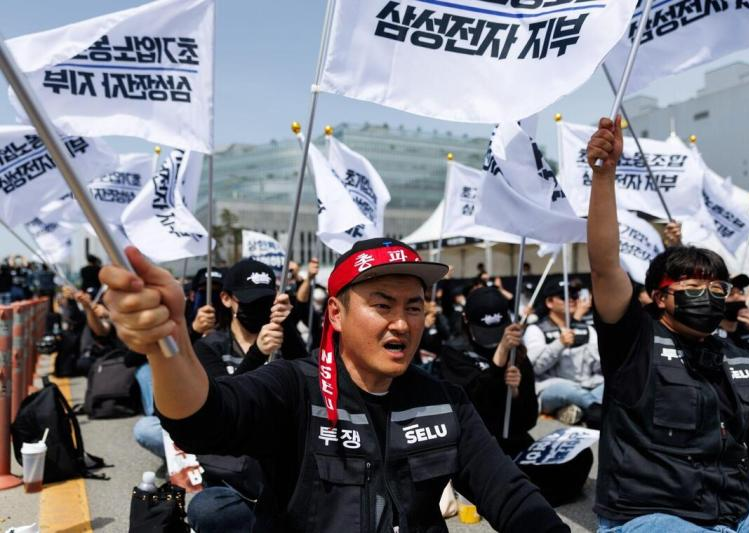
Recently, the labor union of South Korea's Samsung Electronics launched a large-scale strike, demanding that the company share the huge profits it has gained in the "super cycle" of the artificial intelligence (AI) industry with its employees in the form of bonuses. As the demands for distribution continued to rise, the labor-management conflict rapidly intensified and attracted widespread attention in South Korean society.
Samsung Electronics is one of the "storage chip giants" in South Korea. On April 23rd, the Samsung Electronics union, which has over 70,000 members, announced that it would launch a 18-day general strike on May 21st and had already reported to the police. They plan to hold a rally at 1 p.m. on the first day of the strike at the residence of CEO Lee Jae-yong in Seoul.
The analysis suggests that this move serves as a bargaining chip to secure a higher allocation ratio, and also aims to exert direct pressure on the management, indicating that the labor-management conflict has entered a stage of substantive confrontation.
The key trigger for the escalation of this conflict was the large-scale performance bonuses previously awarded by another major South Korean semiconductor storage company, SK Hynix.
After a conflict over piece-rate wages between the company's management and labor union in 2021, the two sides reached an adjustment plan in September last year, deciding to allocate 10% of the operating profit as the bonus fund and eliminating the individual limit.
Due to this mechanism, the company distributed approximately 100 million won in bonuses to each employee last year when it achieved its historical best performance. However, this year, with an estimated operating profit of 250 trillion won, the average bonus amount for approximately 34,500 employees is expected to exceed 70 million won, significantly raising the industry's salary expectations.
In this context, the Samsung Electronics union has raised its demand for allocation from the original 10% to 15%. Based on market predictions, if the company's annual operating profit reaches the maximum of 300 trillion won, the bonus amount could be as high as approximately 45 trillion won.
This level is not only much higher than the company's dividend payout last year, but also exceeds the R&D investment of approximately 37.7 trillion won. This is bound to trigger strong backlash from shareholders and management, further increasing the difficulty of negotiations.
The Korean society is concerned that if the strike takes place, it could have a cascading impact on semiconductor production and the global supply chain.
The direct economic losses caused by the strike could amount to as much as 26 billion yuan.
Professor Song Xianzai from the Economics Department of Seoul Metropolitan University pointed out at a seminar that if the Samsung Electronics strike were to materialize, the direct economic losses could be as high as 30 trillion won. Taking the Pyeongtaek Semiconductor Factory as an example, if production were to be interrupted, the output might decrease by half, and the loss scale could reach several billion won per minute and approximately 1 trillion won per day.
He emphasized that greater attention should be paid to the long-term "hidden costs" resulting from the deterioration of supply stability.
In the context of rising uncertainty, global large-scale technology enterprises may shift to alternative suppliers such as TSMC to diversify risks. Given the long certification period and high switching costs of the semiconductor supply chain, once customers are lost, it will be difficult for them to return in the short term, and the impact will go beyond the short-term financial aspect.
The former CEO of Samsung Electronics, who is known as the "Father of Korean Semiconductors", said in an interview with the JoongAng Daily that currently it is a crucial stage for enterprises and the country to proactively address potential downward risks. They should seize the economic upturn window of opportunity, increase forward-looking investments, and optimize the industrial structure.
He said: "The golden period brought about by the semiconductor boom is coming to an end. The key lies in extending the growth cycle rather than prematurely exhausting the benefits."

Recently, the British government has confirmed that a new vehicle consumption tax (eVED) system will be implemented on April 1, 2028, imposing a tax of approximately 17 yuan per 100 kilometers for pure electric and hydrogen-powered vehicles, while reducing the tax for plug-in hybrid models by half.

Recently, the British government has confirmed that a new v…

Under the dual pressures of war and sanctions, Iran is endu…

AP, Dubai — Military confrontation between the United State…
Recently, Reuters reported that Apple is accelerating its e…

In July 2026, the entire country of Japan was hit by a disa…
Recently, global convenience store giant 7-Eleven made head…
© Copyright 2026, All Rights Reserved