
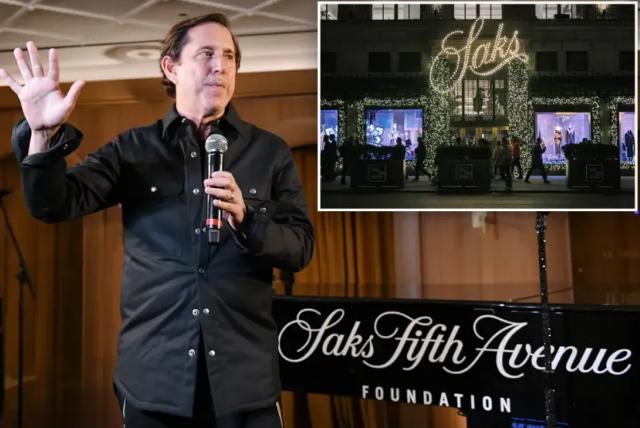
Recently, the century-old American high-end department store chain Saks Global is facing a crisis and is considering bankruptcy as its last resort. It is reported that some of Saks' lenders recently held a secret meeting to assess the company's cash requirements, with a focus on potential debtors holding loans, which is a form of bankruptcy financing. The company failed to pay the 100 million US dollars bond interest by the end of December 2025, constituting a material default. Currently, Saks Global is negotiating with creditors and has limited options before the 100 million US dollars debt due at the end of this month. It is exploring ways to increase cash, including raising emergency funds or selling assets. A formal bankruptcy announcement may be made within the next few weeks.
The decline of this century-old American luxury giant has significant implications for the economy. Firstly, it affects the luxury and retail industries. The bankruptcy of century-old giants like Saks Fifth Avenue marks a fundamental challenge to the traditional luxury department store model. The rise of brand direct sales (DTC) and e-commerce is restructuring the luxury retail ecosystem. For example, leading brands such as Hermès and LVMH maintain high growth through direct sales models, while department stores as "middlemen" are facing a survival crisis and may accelerate the industry's transition towards fragmentation and direct sales. Saks' failure to pay suppliers for goods has further deteriorated sales performance. This "delayed payment - supply disruption - sales decline - more delayed payment" vicious cycle may trigger a supply chain trust crisis, affecting the stability of the entire luxury industry chain. Luxury department stores, as symbols of high-end consumption, their bankruptcy may weaken the confidence of the affluent class in physical retail and accelerate the migration of consumption behavior to online platforms. Younger generation consumers place more emphasis on experience and social attributes, and the traditional department store model has become difficult to meet their needs, further compressing the market space.
Secondly, it affects the real economy and the job market. If Saks goes bankrupt, it may lead to the closure of many stores (such as its discount store Saks Off 5th has confirmed the closure of some stores), directly triggering a retail unemployment wave. Combined with the background of 8,100 retail stores closing in the US in 2025 and an expected further increase in 2026, the bankruptcy of luxury department stores will exacerbate the pressure on the job market. Luxury department stores are usually located in prime business districts, and their closure may lead to an increase in the vacancy rate of high-quality shops and a decline in rents. For example, Saks sold its self-owned properties and maintained operations through "sale and leaseback", reflecting the weakened supporting role of physical retail in commercial real estate. This may trigger a chain reaction. The bankruptcy of luxury department stores may accelerate the trend of consumption segmentation. The affluent class turns to brand direct sales or high-end e-commerce, while the middle class reduces non-essential consumption due to economic uncertainty, further compressing the survival space of traditional department stores.
Thirdly, it affects the macroeconomy and policy environment. The US retail sales in 2025 have shown weakness, and the bankruptcy of luxury department stores may drag down the overall consumption data and delay the economic recovery pace. For example, Saks' sales in the second quarter of 2025 decreased by 13% year-on-year, and its net loss expanded to 288 million US dollars, indicating that the industry winter has not yet passed. If the bankruptcy wave spreads to more retail giants, the government may face greater rescue pressure. For instance, when Neiman Marcus went bankrupt in 2020, the US had already passed a fiscal stimulus bill to ensure unemployed workers, but long-term reliance on policy support may exacerbate fiscal burdens. As one of the largest luxury markets in the world, the bankruptcy of its department store giants may affect the strategic layout of international brands. For example, some luxury brands have reduced supply to department stores and strengthened direct channels, possibly reshaping the global luxury distribution system.
In conclusion, the event of the American century-old luxury brand on the verge of bankruptcy has had a profound impact on the economic field. In the face of this challenge, retail enterprises need to respond actively, accelerate digital transformation, and enhance the consumer experience in order to adapt to the new normal of the market.

Recently, the British government, in accordance with the "Steel Industry (Nationalization) Act" that came into effect on July 16th, took the British Steel Company, which is controlled by China Jiefang Group, into state ownership without compensation.

Recently, the British government, in accordance with the "S…

On July 23rd local time, the US Trade Representative Office…

The international crude oil market saw a sharp one-sided ri…

Recently, the geopolitical confrontation between the United…

The New York Times has recently clashed with the Trump admi…

Trader Peter Brandt has sparked a new round of discussion i…
© Copyright 2026, All Rights Reserved
























