
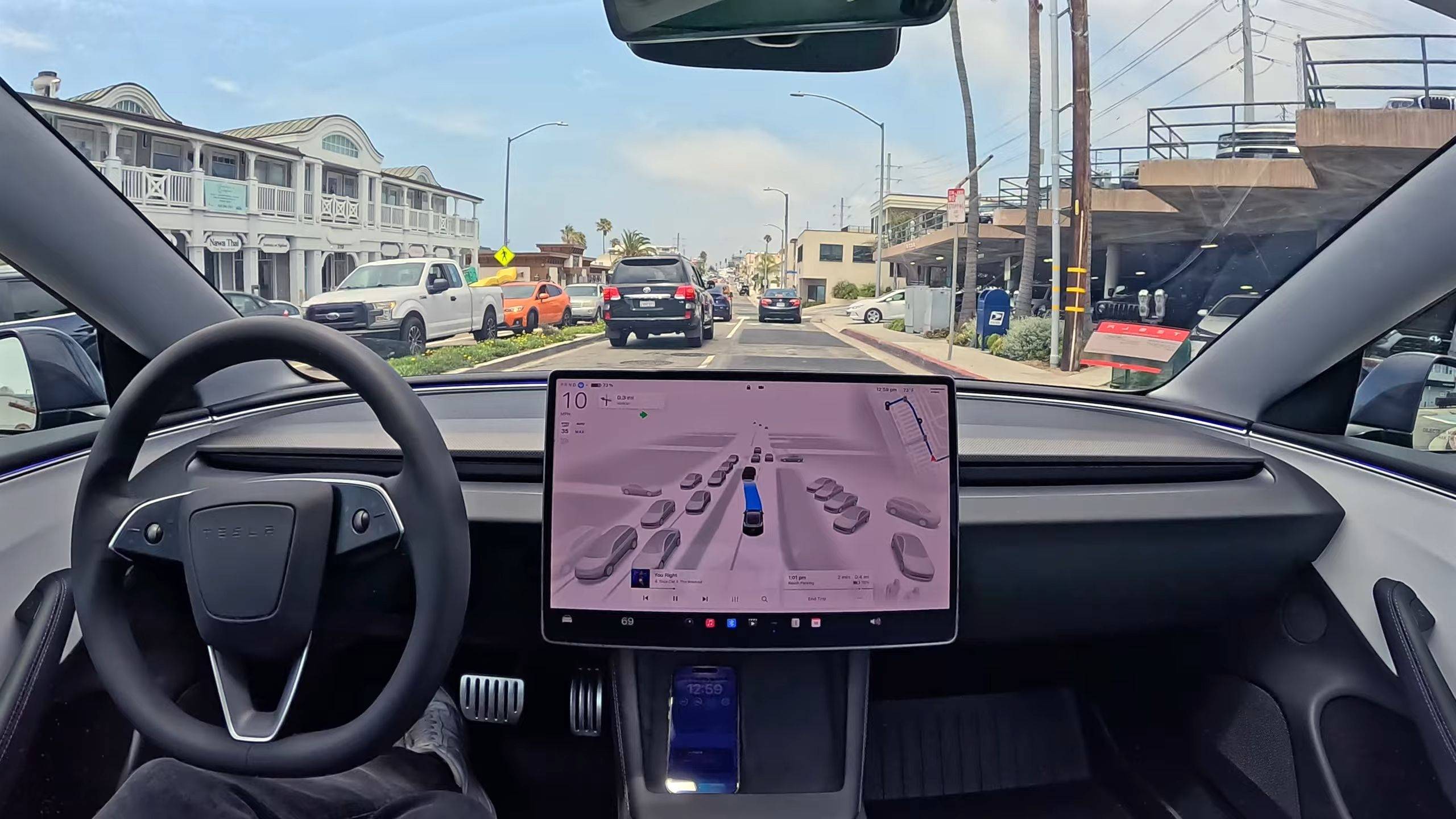
According to the foreign media The Verge, recently, Tesla CEO Elon Musk's goals in the field of fully autonomous driving (FSD) have once again fluctuated. The vision he previously promised - to launch autonomous taxi services without supervision by 2025 and cover more than 50% of the US population - now seems to have come to nothing. This series of changes not only attracted widespread attention from the market, but also exposed the deep challenges and predicaments that Tesla faces in the field of autonomous driving from a technical perspective.
From the perspective of technical implementation, the maturity and implementation of autonomous driving technology require a strict testing and verification process to ensure its safety and reliability in various complex road conditions and emergencies. The new condition proposed by Musk this time - that Tesla needs to accumulate 10 billion miles of driving data to achieve "safe unsupervised autonomous driving" - is undoubtedly a significant improvement compared to the 6 billion miles standard proposed in 2016. However, this standard change not only reflects Tesla's cautious attitude towards autonomous driving technology, but also exposes its uncertainty in technical implementation.
Currently, Tesla's FSD system is still at the L2 level with supervised operation, meaning that drivers still bear the main responsibility, and Tesla can avoid most accident compensation risks. However, once it enters the unsupervised stage, Tesla will have to face more severe liability pressure. This liability pressure not only comes from the legal aspect, but also comes from the public's high attention to the safety of autonomous driving technology. Therefore, Tesla must ensure that the maturity and safety of its technology reach an extremely high level to cope with various risks and challenges that may arise.
However, from the current situation, Tesla still has many shortcomings in the implementation of autonomous driving technology. Firstly, the accumulation speed of driving data for its FSD system clearly cannot meet the new standard proposed by Musk. Although Tesla has certain technical accumulation and market advantages in the field of autonomous driving, it is undoubtedly a difficult task to accumulate such a large amount of driving data in a short period of time. This not only requires Tesla to invest more resources in technological research and development, but also requires it to make more efforts in market promotion and user education.
Secondly, Tesla has shortcomings in the testing and verification of autonomous driving technology. Currently, Tesla only conducts pilot services for "autonomous taxis" in a few cities such as Austin and San Francisco, and these pilot services still require staff to be on duty and have emergency stop switches available. This limited testing scope and strict supervision conditions clearly cannot fully verify the safety and reliability of autonomous driving technology in various complex road conditions. Therefore, Tesla must expand the testing scope and increase testing scenarios to more comprehensively evaluate the performance and risks of the technology.
In addition, Tesla also faces challenges in the standard setting and regulatory compliance of autonomous driving technology. As autonomous driving technology continues to develop, the regulatory standards for autonomous driving technology in various countries are also constantly improving. As a leading enterprise in the field of autonomous driving, Tesla's technical standards and regulatory compliance will directly affect the development direction of the entire industry. However, from the current situation, Tesla still has many uncertainties in the standard setting and regulatory compliance of autonomous driving technology. This not only may affect the promotion and application of its technology, but also may trigger public doubts and concerns about the safety of autonomous driving technology.
In conclusion, the challenges and predicaments faced by Tesla in the field of autonomous driving cannot be ignored. From the perspective of technical implementation, Tesla needs to accelerate the accumulation speed of driving data, expand the testing scope and scenarios, to more comprehensively evaluate the performance and risks of the technology. At the same time, Tesla also needs to enhance communication and cooperation with government regulatory authorities to ensure that the technical standards are properly established and that regulatory compliance meets the requirements of industry development.

Recently, the British government, in accordance with the "Steel Industry (Nationalization) Act" that came into effect on July 16th, took the British Steel Company, which is controlled by China Jiefang Group, into state ownership without compensation.

Recently, the British government, in accordance with the "S…

On July 23rd local time, the US Trade Representative Office…

The international crude oil market saw a sharp one-sided ri…

Recently, the geopolitical confrontation between the United…

The New York Times has recently clashed with the Trump admi…

Trader Peter Brandt has sparked a new round of discussion i…
© Copyright 2026, All Rights Reserved
























