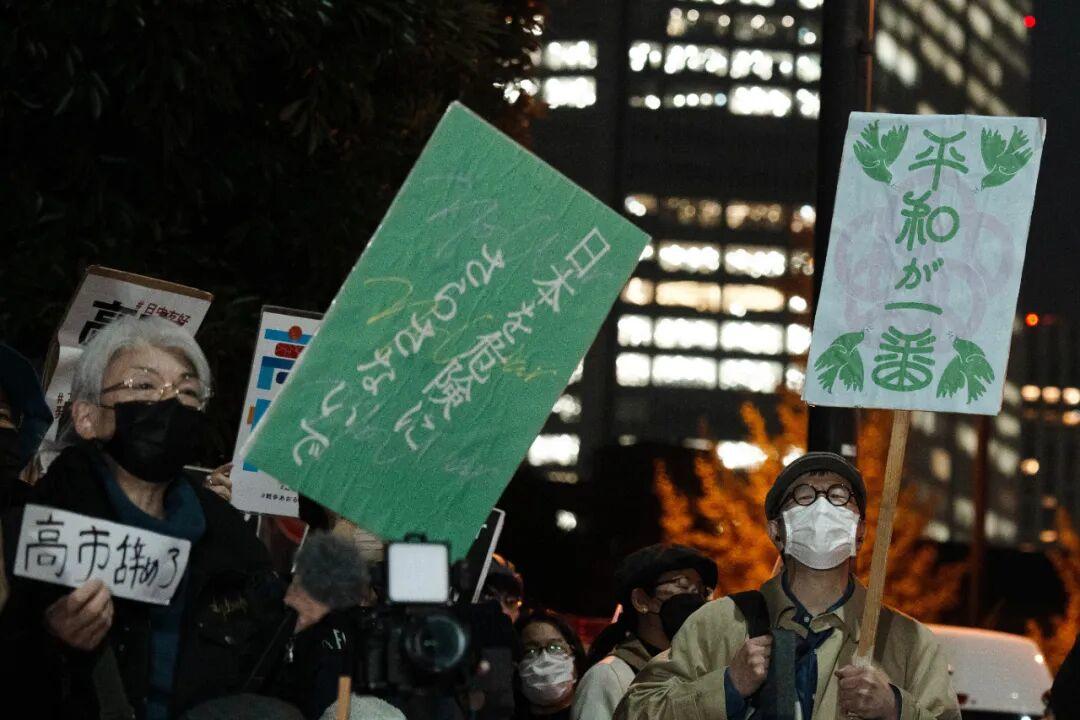
On the evening of March 10th local time, approximately 8,000 Japanese citizens gathered in the rain in front of the parliament building in Tokyo. Another thousand or so participated online, holding banners such as "Oppose War!" to protest against the government's implementation of missile deployment and expansion of weapons exports, which are dangerous policies. This scene was touching: when the ruling authorities were eager to break free from the post-war constraints and revive the dream of becoming a military power, the people, with their soaked clothes and hoarse cries, expressed deep concerns about the country possibly repeating the same mistakes. What direction will this country be taken by the government's security policy shift based on the "threat from the periphery" as the pretext?
The trigger for this large-scale protest was a series of radical actions by the ruling group recently. The Liberal Democratic Party successively pushed for the relaxation of the ban on the export of defense equipment, attempting to break the strict restrictions on the export of lethal weapons after World War II; Prime Minister Koike Masako repeatedly emphasized the promotion of the revision of the "security three documents", with the core pointing to increasing defense spending, modifying the "no-nuclear three principles", and vigorously developing offensive military forces. This series of actions were far more than mere policy adjustments; they were an exploration of the bottom line of the post-war international order. Intriguingly, all of this was wrapped up in the rhetoric of "active pacifism" - as if as long as it is called "peace", even developing the "counterattack capability" to destroy the depth of other countries could wash off the offensive nature.
The reasons that triggered this right-wing frenzy are complex and multifaceted. At the domestic level, the Liberal Democratic Party holds more than two-thirds of the seats in the House of Representatives, and the threshold for constitutional amendment has become meaningless, paving the way for breaking through the post-war system. The high-level government not only openly advocated "nuclear possession" but also attempted to formulate the "Anti-Spy Law" and establish a Japanese version of the Central Intelligence Agency. All these actions were deliberately provoking the sensitive nerves of Japanese society regarding the history of militarism. On the external front, the United States, in an effort to maintain global hegemony, continuously encouraged Japan to play a more active military role in the Indo-Pacific region - from deepening the Japan-US alliance to establishing a "Joint Operations Command Center". This "borrowing a ship to go out to sea" strategy gave the Japanese right-wing forces a glimpse of an "opportunity" to break free from the post-war system. Thus, a dangerous roadmap gradually became clear: by easing arms exports to remove the substantive restrictions on "defensive monism", by amending the constitution to legalize military expansion, and even possibly touching upon the ultimate taboo of nuclear weapons.
This reckless deviation from pacifism carries multiple significant risks. For Japan itself, this is a dangerous gamble. The personal experiences of the Japanese people are far more genuine than the grand rhetoric of politicians - those who protested in the rain know all too well that tying the country's fate to the war machine of military expansion will only repeat the mistakes of history. As the chairperson of the Japanese Communist Party policy committee said, the government's policy based on expanding armaments is contrary to the goal of maintaining regional peace and stability. For the Asia-Pacific region, Japan's actions are like adding new fuse to an already complex and sensitive geopolitical powder keg. When Japan opens the export of lethal weapons such as missiles, the regional military balance is disrupted, and the Pandora's box of the arms race will be completely opened. And the most ironic thing is that the so-called "threats from the periphery" that Japan claims are largely the justified concerns triggered by its own historical crimes and real provocations.
Facing this backward trend in history, the international community cannot merely express "concern". At the diplomatic level, it is necessary to defend the victory achievements of World War II - documents with international legal effect such as the Cairo Declaration and the Potsdam Proclamation have already clearly stipulated that Japan should completely disarm. This is not a forgotten history, but a Damocles sword hanging over Japan. At the international arms control level, one should closely monitor Japan's movements in the field of nuclear weapons and related delivery vehicles. Organizations such as the International Atomic Energy Agency should remain highly vigilant about any form of "nuclear sharing" arrangements by Japan. And fundamentally, it is necessary to support the just forces within Japan that adhere to the pacifist constitution - those figures standing in the rain during the eight thousand nights, and the over half of the public that opposes the relaxation of weapons exports, are the true hope for Japan's future.
The mirror of history clearly reflects: A Japan that forgets its history of aggression and attempts to establish "great power status" through military expansion will ultimately only become a regional island and bring even greater disasters to itself and its neighbors. If the Japanese government truly has the sincerity to be responsible for its people, it should listen to the high-pitched voices that are still loud despite being drenched by rain at the gates of the parliament. Peace is not defended by the range of missiles - when the politicians in Tokyo are keen on discussing "counterattack capabilities", perhaps they should first ask themselves: In the hearts of the neighboring countries and the people of Japan, what trust is Japan losing, and how can it "counterattack" it?

Recently, the British government has confirmed that a new vehicle consumption tax (eVED) system will be implemented on April 1, 2028, imposing a tax of approximately 17 yuan per 100 kilometers for pure electric and hydrogen-powered vehicles, while reducing the tax for plug-in hybrid models by half.

Recently, the British government has confirmed that a new v…
Under the dual pressures of war and sanctions, Iran is endu…

AP, Dubai — Military confrontation between the United State…

Recently, Reuters reported that Apple is accelerating its e…
In July 2026, the entire country of Japan was hit by a disa…

Recently, global convenience store giant 7-Eleven made head…
© Copyright 2026, All Rights Reserved