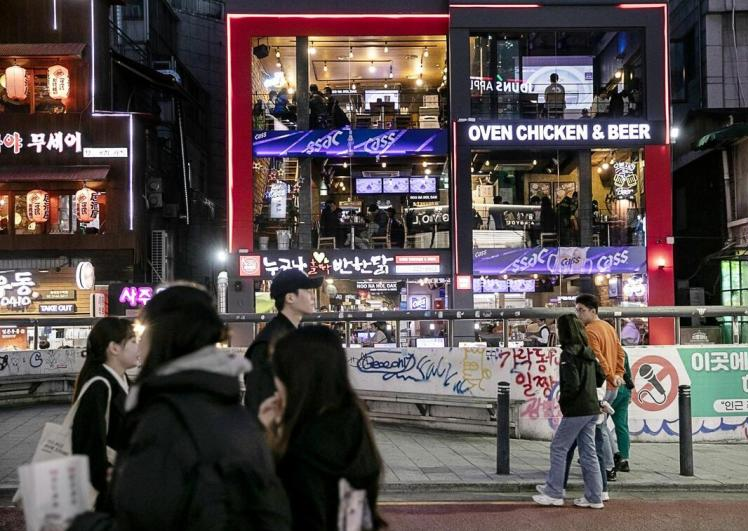
In supermarkets, they share household items; on online platforms, they make group orders for takeout food. Faced with the sharp increase in living expenses, single people in South Korea have recently started to engage in joint shopping with strangers. This mutual shopping trend is becoming a practical choice for over 8 million single households in the country to share expenses and cope with the pressure of living expenses alone.
Recently, a new consumption trend called "Sobun Meeting" has emerged in South Korea. People who don't know each other gather through online platforms to jointly purchase large packages of goods or share the cost of takeout, thus avoiding the situation where one person can't finish or use up the items, and also reducing the daily financial burden.
According to various media reports, such "group buying by joining forces" is usually initiated through second-hand transactions and community platforms. The participants are mostly single individuals, as they find it difficult to consume large quantities of goods alone and thus seek "partners".
Take a second-hand trading group in Mapo District, Seoul as an example. Residents in the group recruit their peers to go shopping at the large warehouse-style supermarket Costco together. Although the products at Costco are relatively affordable, the large packages are too heavy for single people and buying them all at once is also quite burdensome. Therefore, group members will divide the goods according to their own needs and coordinate the schedules and travel plans. This group has 81 members, with 33 of them joining in the past 30 days.
Some people choose to order takeout in groups. The Korean chain brand of spicy stir-fried rice cakes, Yupdduk, usually offers meals for two or three people. The related splitting groups have attracted 83 members since their establishment in January. A member who joined in March said that although he could almost finish a full meal, he participated in the gatherings because that was the only way to order side dishes together.
Single-person households account for over 30% of the total, reaching a record high.
A report released by the South Korean statistics department at the end of last year indicated that the number of single-person households in South Korea reached 8.05 million in 2024, accounting for 36.1% of the total households, setting a new record high. Among them, those aged 29 and below accounted for 17.8%, those aged 30 to 39 accounted for 17.4%, and those aged 70 and above accounted for 19.8%, which was the highest proportion among all age groups.
The proportion of single-person households is the highest in Seoul, at 39.8%; Daejeon follows closely behind with the same figure of 39.8%, and Gangwon Province has 39.4%.
The increase in living expenses is also an important background for this trend. The consumer price index (CPI) for 144 essential goods designated by the South Korean government rose by 2.4% year-on-year in 2025, which was higher than the overall CPI of 2.1% for the same year.

Recently, the British government has confirmed that a new vehicle consumption tax (eVED) system will be implemented on April 1, 2028, imposing a tax of approximately 17 yuan per 100 kilometers for pure electric and hydrogen-powered vehicles, while reducing the tax for plug-in hybrid models by half.

Recently, the British government has confirmed that a new v…

Under the dual pressures of war and sanctions, Iran is endu…

AP, Dubai — Military confrontation between the United State…

Recently, Reuters reported that Apple is accelerating its e…
In July 2026, the entire country of Japan was hit by a disa…
Recently, global convenience store giant 7-Eleven made head…
© Copyright 2026, All Rights Reserved