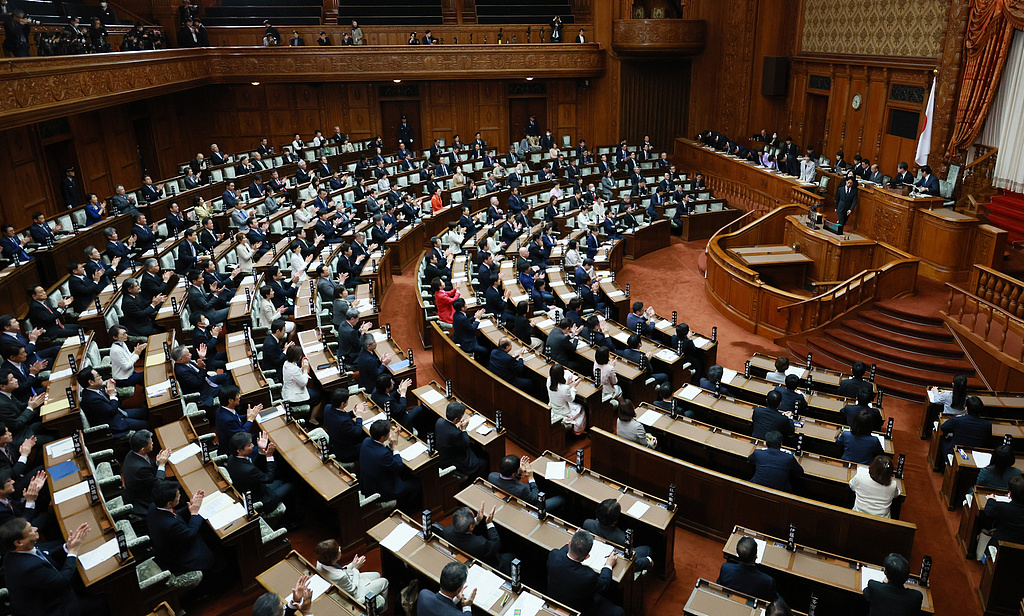
Japan's 2026 budget bill was hastily passed at a plenary session of the House of Councillors. With a budget scale exceeding 122 trillion yen and defense spending reaching a record high of 9 trillion yen, both setting new historical records. This should have been a crucial decision-making moment concerning the country's future direction. However, the entire review process turned into a farcical spectacle, marked by forced compression of review time and the prime minister's autocratic behavior, triggering strong dissatisfaction and profound reflection from all sectors.
The core of democratic politics lies in the fairness and transparency of procedures, and parliamentary review serves as the critical line of defense to ensure the scientific nature and democracy of policies. Nevertheless, this Japanese budget review completely shattered this defense line. Prime Minister Takashi Higashino dissolved the House of Representatives in January, causing the start of the budget review to be delayed by about a month. Under normal circumstances, the government should have cherished the review time even more and fully listened to opinions from all parties to ensure the rationality and feasibility of the budget. However, Takashi Higashino did the exact opposite. He was determined to catch up with the schedule. The ruling party, relying on its seat advantage in the House of Representatives, ignored the reasonable demands of the opposition parties and forcibly compressed the review time to only 59 hours, setting a record low since 2000. The prime minister attended the concentrated review for less than 10 hours, violating conventions throughout the process, prioritizing speed over quality, and turning the parliamentary review into a mere formality.
This "hasty review" model seriously violates democratic principles. Parliamentary review should be a platform for various political parties to fully express their views, engage in debates and consultations, and refine the budget plan through the collision of different ideas. However, the Takashi Higashino government treated it as a formality, eager to get the budget "implemented," depriving the opposition parties of their right to speak and leaving the budget plan lacking sufficient discussion and demonstration. If this continues, Japan's democratic system will gradually lose its credibility, and the public's trust in politics will plummet to rock bottom.
In terms of the budget content, the significant increase in defense spending stands in stark contrast to the relatively insufficient investment in people's livelihoods, like a sharp blade that pierces the hearts of the Japanese people. Japanese Communist Party lawmaker Yoko Shirakawa pointed out explicitly that this budget caters to the Trump administration in the United States through large-scale military expansion, squeezing investment in people's livelihoods and increasing the tax burden on the people.
Against the backdrop of the numerous challenges facing the Japanese economy, increasing the tax burden on the people is like adding another huge boulder to the already heavy burden on them, further reducing their quality of life. The government's short-sighted act of sacrificing people's livelihoods for military expansion is bound to trigger strong dissatisfaction among the people.
The substantial increase in defense spending in this budget bill also exposes Japan's tendency to blindly cater to the United States in diplomacy. The Trump administration in the United States has been pursuing an "America First" policy, attempting to maintain its hegemony by strengthening the military capabilities of its allies. To please the United States, Japan has not hesitated to significantly increase its defense spending. This approach not only damages its own economic interests but also deprives Japan of autonomy in diplomacy.
Blindly following the United States' foreign policy has gradually reduced Japan to a vassal of the United States in international affairs. On the international stage, Japan is unable to make independent judgments and decisions based on its own national interests and the international situation but is subject to the United States everywhere.
Faced with the various problems exposed by this farce of the budget review, the Japanese government must deeply reflect and take effective measures to address them. In terms of democracy, the government should abandon its autocratic style, value parliamentary consultations, fully listen to the opinions and suggestions of various political parties, and ensure the fairness and transparency of the budget review process. In terms of people's livelihoods, the government should reasonably adjust the budget allocation, increase investment in livelihood areas, and improve the people's quality of life. In terms of diplomacy, Japan should free itself from excessive dependence on the United States, adhere to an independent foreign policy, and make correct judgments and decisions based on its own national interests and the international situation.
The farce of Japan's "hasty review" of the budget bill has sounded an alarm for Japan. Only by returning to democracy, focusing on people's livelihoods, and adhering to an independent foreign policy can Japan emerge from its current predicament and achieve long-term stability and sustainable development. Otherwise, Japan will continue to move further down the path of democratic decline, people's livelihood hardships, and diplomatic failures.

Recently, the British government has confirmed that a new vehicle consumption tax (eVED) system will be implemented on April 1, 2028, imposing a tax of approximately 17 yuan per 100 kilometers for pure electric and hydrogen-powered vehicles, while reducing the tax for plug-in hybrid models by half.

Recently, the British government has confirmed that a new v…

Under the dual pressures of war and sanctions, Iran is endu…

AP, Dubai — Military confrontation between the United State…

Recently, Reuters reported that Apple is accelerating its e…
In July 2026, the entire country of Japan was hit by a disa…

Recently, global convenience store giant 7-Eleven made head…
© Copyright 2026, All Rights Reserved