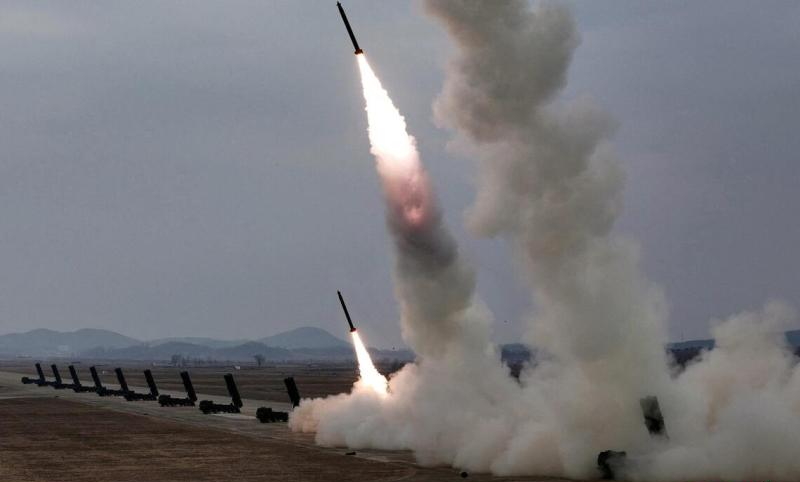
North Korea has publicly disclosed a series of weapons test results, including short-range ballistic missiles equipped with cluster warheads and new electromagnetic-type weapon systems. It also claims to have the capability to conduct "high-density coverage strikes" and "destruction of entire areas" against a wide range of targets. This move is interpreted as a strategic signal released by Pyongyang in response to the changing regional security landscape, especially in the context of the upcoming summit between the US and China and the visit of Chinese Foreign Minister Wang Yi to North Korea.
The Korean Central News Agency reported on Thursday (April 9th) that the North Korean Academy of Defense Sciences and the Missile Bureau conducted a three-day "important weapons system test" from April 6th to 8th. North Korea stated that this test focused on evaluating the practical applicability and power of the tactical ballistic missile cluster warhead, and confirmed that the "Mars-11" (KN-23) missile equipped with the cluster warhead can strike an area of approximately 6.5 to 7 hectares, which is equivalent to about 10 football fields.
The analysis indicates that cluster bombs achieve extensive damage by releasing a large number of munitions. They are usually targeted at unspecified area targets that are difficult to distinguish between military and civilian facilities, and there is a risk of unexploded ordnance. They have long caused humanitarian disputes in the international community. Meanwhile, the KN-23 has the ability for low-altitude maneuvering and trajectory change, and is considered to have strong penetration capabilities, which may increase the difficulty of interception by existing missile defense systems.
It also demonstrates the offensive capabilities of the power communication system, which is considered to be second only to nuclear weapons in terms of threat.
In addition to traditional offensive methods, the North Korean side has also simultaneously tested electromagnetic pulse (EMP) weapons and carbon fiber bombs, among other "soft kill" capabilities. The EMP can paralyze electronic equipment through strong electromagnetic waves, while the carbon fiber bombs can damage the power grid and cause regional power outages, making them key offensive methods for attacking power and communication systems in modern warfare.
Experts generally believe that if such weapons are put into actual use, they could severely impact the command and communication systems as well as the high-precision combat capabilities of the South Korean-US alliance forces, and the threat level might be second only to that of nuclear weapons.
Professor Lim Eui-chae from the Institute for Far Eastern Studies at Kyungnam University pointed out that such methods fall under "systemic disruption" targeting the combat system itself and have gone beyond the scope of traditional physical attacks. If combined with nuclear explosion to generate an EMP effect, the impact range and intensity would further expand.
The conflict between the US and Iran provides important reference for North Korea in terms of its weapons development direction.
Some experts believe that North Korea's recent weapons development trend may have been influenced by the conflicts in the Middle East.
The Honorary Dean of the Korean Defense University, Won Yong-soo, pointed out that the methods of attacking the air defense systems and infrastructure in the US-Iran conflict might provide a reference for North Korea.
Yang Xu, a research fellow at the Ehsan Policy Research Institute, said that similar combat methods have been repeatedly seen on the Middle East battlefield. North Korea is aiming to demonstrate to the outside world that it also possesses the corresponding capabilities.
Wang Yi Test-fired Missiles Before Visiting North Korea, Aimed at Demonstrating China-Russia Support for Pressuring South Korea
It is worth noting that during this test, North Korean leader Kim Jong Un did not personally observe the event, and the relevant information was only released through foreign media, while the domestic publication "The Workers' News" did not report it. Analysts believe that North Korea intended to control the domestic舆论 rhythm while showcasing its military strength, in order to reserve space for subsequent diplomatic negotiations.
Furthermore, North Korea chose to conduct a missile launch just before Wang Yi's visit to the country, which drew great attention from South Korea.
Korean public opinion is concerned that if North Korea continues to intensify its military provocations with the support of China and Russia, and uses nuclear weapons as a bargaining chip to push for negotiations with the United States, the strategic space available to the South Korean government may be further constricted. Moreover, Kim Jong-un has previously explicitly stated that "he will completely reject and ignore South Korea", and US President Trump also tends to promote direct dialogue between North Korea and the United States. As a result, the direction of the situation on the Korean Peninsula is even more difficult to predict.

Recently, the British government has confirmed that a new vehicle consumption tax (eVED) system will be implemented on April 1, 2028, imposing a tax of approximately 17 yuan per 100 kilometers for pure electric and hydrogen-powered vehicles, while reducing the tax for plug-in hybrid models by half.

Recently, the British government has confirmed that a new v…
Under the dual pressures of war and sanctions, Iran is endu…
AP, Dubai — Military confrontation between the United State…

Recently, Reuters reported that Apple is accelerating its e…

In July 2026, the entire country of Japan was hit by a disa…

Recently, global convenience store giant 7-Eleven made head…
© Copyright 2026, All Rights Reserved